(With deep condolences to all the families and friends of passengers and crew of Malaysia Airlines Flight MH17. Not to forget as well, the pain and suffering of the people of Gaza)
7 Times Militaries Have Shot Down Civilian Planes
Updated by Dylan Matthews on July 17, 2014, 5:10 p.m. ET @dylanmatt dylan@vox.com
US intelligence reports that Malaysia Airlines Flight 17 was shot down, making it one of the highest-casualty airliner shoot-downs in the history of aviation. But it's hardly the first. Events like this — though usually much smaller in scale — have occurred about two dozen times. Many instances were part of ongoing wars, such as Nazi Germany's shoot-down of a British Overseas Airways Corporation flight from Lisbon to London in 1943, or Zimbabwean rebels' shoot-downs of two Air Rhodesia flights in 1978 and 1979.
But in those cases, the countries involved were at war with each other. In contrast, Flight 17 was going from Amsterdam to Kuala Lumpur, and neither the Netherlands nor Malaysia have much of any involvement in the Ukrainian civil war. And the death toll — there were 295 crew and passengers, and, to the best of our knowledge, no survivors — is extremely high.
With that in mind, here are seven previous airliner shoot-downs that could provide some clue as to what the consequences of the crash will be. The list is hardly comprehensive but gives a sense of how these situations are handled.
1) Korean Air Lines Flight 007 (1983)
Also known as "that time the Soviet Union killed a sitting US Congressman." KAL007 (a Boeing 747-230B) was shot down by a Soviet fighter plane on September 1, 1983, killing all 269 passengers and crew, including Larry McDonald, a Congressman from Georgia then in his fourth term. An ardent anti-Communist and believer in various conspiracy theories about the Rockefellers, the Trilateral Commission, and the Council on Foreign Relations plotting to bring about a socialist world government, McDonald also was president of the John Birch Society, the ultra-right-wing conspiracist group.
The fact that the crash killed McDonald would fit perfectly into his particular set of conspiracy theories, but there's no evidence that what happened was more complicated than KAL007 entering Soviet airspace and being shot down as an intruder. This International Civil Aviation Organization report from 1993, incorporating documents released by Russian president Boris Yeltsin that Soviet leaders had previously withheld, summarizes what we know well, and finds Soviet personnel appearing baffled and concerned by the presence of an unknown aircraft, rather than determined to strike intentionally, though their decision to strike without attempting to establish contact with the plane was reckless.
The direct response to the attack — and subsequent Soviet attempt at a cover-up — was largely rhetorical. President Reagan condemned the shoot-down as a "crime against humanity" which "must never be forgotten." The US responded to Soviet intransigence by releasing substantial amounts of classified material to back up the charge that the Soviets (accidentally or not) shot the plane down. An unintended side effect of that was to weaken the US's ability to monitor Soviet communications through Japan "According to various unnamed Japanese officials, changes made in the Soviet codes and frequencies following the American disclosures reduced the effectiveness of Japanese monitoring by 60 percent," David M. Johnson noted in a write-up on the intelligence losses for Harvard and the Center for Information Policy Research.
The shoot-down led to the expansion of the Global Positioning System to civilians, which Reagan announced in the wake of the shoot-down. It would have been harder for the KAL pilots to drift into Soviet airspace with satellite navigation technology.
2) Iran Air Flight 655 (1988)
Though the Soviets did it first, the US also once accidentally downed a civilian airliner (an Airbus A300B2-203) carrying about 300 people on it. On July 3, 1988, as the Iran-Iraq war was winding down, US and Iranian ships were involved in some skirmishes in the Persian Gulf. An Airbus A300 took off from a nearby airport, one which was used for both military and civilian purposes. An American cruiser, the USS Vincennes, mistook the plane for an F-14, an American fighter plane that we had sold to Iran before the 1979 revolution, and launched two missiles, downing the plane and killing everyone on board.
President Reagan called the event a "terrible human tragedy," and stated "we deeply regret any loss of life." Iran's UN ambassador condemned the action as ''criminal act,'' an ''atrocity'' and a ''massacre," while the US insisted it was a misunderstanding. Then-Vice President George H.W. Bush called the idea the US would have shot down the plane deliberately "offensive and absurd," and argued that allowing passenger flights out of an airport as a naval battle was underway was irresponsible of the Iranians. "They allowed a civilian aircraft loaded with passengers to proceed on a path over a warship engaged in battle,'' Bush said. ''That was irresponsible and a tragic error.''
Iran sued the United States in the International Court of Justice, and the American government eventually agreed in 1996 to pay $61.8 million ($93.7 million today) to the families of victims; notably, that amount was 1/30th of the compensation the US secured from Libya for victims of the Lockerbie plane bombing that same year. The US government has never apologized for shooting down the plane, beyond Reagan's initial statement, and Max Fisher has noted the event contributes to Iranian mistrust of American intentions to this day.
3) Itavia Flight 870 (1980)
This is a case where we still don't really know the true story. On June 27, 1980, an Itavia Airlines (a DC-9) flight from Bologna to Palermo with 81 passengers and crew crashed in the Tyrhennian Sea, near Sicily. The New York Times' Elisabetta Povoledo reports that the "most widely accepted theory behind the crash" — for which an Italian court last year said there was "abundantly" clear evidence" — was that a stray missile from an aircraft hit the plane, but any information about which country's aircraft it was, or why, is still very much up in the air.
An Italian judge, Rosario Priore, presented the theory that there was a NATO plot to shoot down a plane carrying Libyan dictator Muammar Gaddafi, and the Itavia jet got caught up in that operation. He presented radar evidence suggesting the presence of US, French, Libyan, and British military operations near to where the plane crashed. Francesco Cossiga, the prime minister at the time, said decades later that the plane was shot down by French military personnel. But neither his nor Priore's claims have been proven.
4) El Al Flight 402 (1955)
On July 27, 1955, an El Al (a Lockheed Costellation) flight from Vienna to Tel Aviv flew into Bulgarian airspace and was shot down by two Bulgarian MiG fighters. All 58 people on board were killed. After initially denying involvement, Bulgaria admitted to having shot the plane down. Despite occurring during a low point in relations between the Soviet bloc (including Bulgaria) and the US and its allies (including Israel), international fallout was minimal.
Eight years after the attack, Bulgaria agreed to pay a total of $195,000 ($1.5 million in current dollars) to Israel, having already compensated non-Israeli passengers.
5) Cathay Pacific Airways (1954)
On July 23, 1954, mainland China's People's Liberation Army fighters shot down a Cathay Pacific Airways (the airline of Hong Kong, then under British control) Douglas C-54 Skymaster flying from Bangkok to Hong Kong; 10 out of the 19 passengers and crew died. In apologizing for the attack to Britain days later, the Chinese government stated that they had thought the plane was a military aircraft from the Republic of China n (Taiwan) on an attack mission against Hainan Island (near where the shoot-down took place).
However, the initial tragedy was compounded when two PLA fighters engaged three US Navy planes that were searching for survivors; the two PLA planes were shot down. While admitting fault and promising compensation in the case of the civilian plane, China claimed that it was faultless in the confrontation with the US. President Eisenhower, in turn, alleged the harsh tone toward the US and conciliatory tone toward Britain in reference to the Cathay plane was a Communist plot to split the allies.
It's hard to say the incident made relations between the Allies and mainland China much worse than they already were, but it risked bringing the Allies further into the battles that were then occurring between the People's Republic of China and the Republic of China. Given that the Eisenhower administration was apparently considering using nuclear weapons on the ROC's behalf, any heightening of the tensions there was dangerous.
6) Libyan Arab Airlines Flight 114 (1973)
On February 21, 1973, a Libyan Arab Airlines (a wholly owned part of the Libyan government) Boeing 727 flying from Tripoli to Cairo got lost and flew over the Sinai peninsula, which had been under Israeli control since the Six-Day War in 1967. After giving signals to land and firing warning shots, Israeli jets shot down the plane, killing 108 of the 113 people on board, and leaving four passengers and a co-pilot alive.
David Elazar, the chief of staff of the Israeli armed forces, took responsibility for ordering the shoot-down. Defense Minister Moshe Dayan called the event an "error of judgment" and the Israeli government compensated the families of victims. Libya condemned the attack as "a criminal act" while the Soviets called it a "monstrous new crime."
7) Siberia Airlines Flight 1812 (2001)
Perhaps the strangest precedent for the Malaysian Airlines crash in Ukraine is a shoot-down in 2001 caused by military forces in … Ukraine. On October 4, 2001, 64 Siberia Airlines passengers and 12 crew members onboard a Soviet-made Tupolev Tu-154 en route from Novosibirsk to Tel Aviv were killed when the plane was shot down over the Black Sea by a Ukrainian missile.
It took a while for Ukraine to admit that was what had happened, but after pressure from Russian investigators, Ukraine's then-president, Leonid Kuchma, accepted that the Ukrainian military was at fault. The day of the shoot-down, the Ukrainian military was conducting a massive military exercise which involved shooting 23 missiles at drones. "Experts say that the radar-guided S-200, among the farthest-flying and most capable antiaircraft missile in the arsenal of former Soviet nations, simply locked onto the Russian airliner after it raced past the destroyed drone some 20 miles off the Crimean coast," the New York Times' Michael Wines reported.
Kuchma accepted the resignation of his Minister of Defense, Oleksandr Kuzmuk, following the admission that the military was at fault. From 2003 to 2005, Ukraine paid $15.6 million to families of victims following a deal with the government of Israel.
Sunday, 20 July 2014

Wednesday, 16 July 2014
My Utterly Gorgeous Read 2
I first read this book something like 20 years ago in its original Indonesian. I have read other books by Pram (as Indonesians refer to the author) but Gadis Pantai remains my evergreen favourite.
Pramoedya Ananta Toer (1925 - 2006) is generally regarded as the greatest of Indonesian novelists. The immediacy, clarity and direct emotion of “The Girl From the Coast,” the unpretentious story of a poor village girl torn from her family and married to an arrogant nobleman, make it a compulsively readable novel.
The girl from the coast, a slender, pretty but otherwise ordinary 14-year-old is plucked from her life of ceaseless labour as a fisherman’s daughter and betrothed to the Bendoro, a local wealthy Javanese aristocrat whose luxurious lifestyle is light-years beyond anything the girl and her family have ever seen or imagined. To me it is the story about the oppression of the women in a feudal society. It was loosely based on the real experience of Pramoedya's grandmother.


Gadis Pantai
Karya Pramoedya Ananta Toer
Gadis Pantai adalah seorang anak gadis yang cantik dan cerdik dari sebuah keluarga miskin di perkampungan nelayan. Kecantikannya memikat hati seorang pembesar berketurunan Jawa yang bekerja untuk Belanda. Pada usia 14 tahun dia diambil menjadi isteri pembesar tersebut yang di gelar Bendoro. Ibu bapa gadis pantai menyangka mereka memberikan kehidupan yang lebih baik kepadanya dengan mengahwinkannya dengan Bendoro. Sewaktu pernikahan hanya ketua kampung yang datang dengan membawa sebilah keris yang mewakili Bendoro.
Dengan berat hati gadis pantai meninggalkan keluarga dan menjadi Mas Nganten dirumah pembesar tersebut. Dia diberikan kemewahan namun tidak kebebasan. Gadis Pantai tidak diakui sebagai isteri sebaliknya hanya dijadikan tempat melepaskan nafsu sang pembesar. Dalam erti kata sebenar-benar walau diberi kemewahan taraf Mas Nganten didalam rumah tangga Bendoro tidak lebih dari seorang hamba atau gundik. Pada masa sekarang Bendoro ini boleh dikategori sebagai seorang paedophile.
Di rumah besar tersebut dia seolah-olah orang asing bilamana orang-orang terlalu mengikut protokol kerana takut akan kemurkaan Bendoro. Demi mengisi kekosongan hidupnya, Gadis Pantai belajar, membatik dan beberapa pekerjaan lagi, lebih-lebih lagi setelah pembantunya dihalau pembesar.
Namun setelah melahirkan seorang bayi, segala-galanya berakhir begitu sahaja ketika bayinya berumur tiga bulan. Dia diceraikan dan bayinya diambil Bendoro. Perkara seperti ini sememangnya telah merupakan perkara biasa kepada Sang Bendoro. Mengambil gadis-gadis muda dari keluarga miskin untuk dijadikan sebagai "isteri percubaan" kemudian dihalau pulang kekampung setelah melahirkan anak. Dirumah agamnya terdapat beberapa remaja lelaki merupakan anak-anak Bendoro dengan isteri-isteri percubaan yang telah diceraikannya. Si Bendoro dari keturunan bangsawan yang kaya raya hanya layak dikahwini oleh perempuan bangsawan yang setaraf dengan beliau sahaja. Demi meneruskan hidup gadis pantai memilih untuk pergi ke Blora, menolak untuk pulang ke kampung halaman kerana malu dengan jiran tetangga.
Novel ini membawa persoalan tentang perbezaan kelas yang sangat ketara pada era penjajahan Belanda di Indonesia. Ia juga merupakan kritikan yang sangat tajam tentang kemanusiaan dan bagaimana mudahnya kelas bawahan ditindas mereka yang kaya dan berkuasa yang juga mengakui diri mereka sebagai golongan yang taat kepada agama. Golongan priyayi (bangsawan) seperti Bendoro banyak mempelajari selok belok agama, namun mereka juga yang sering menindas dan mengambil kesempatan keatas orang miskin. Orang bawahan yang miskin juga disekat dari bersuara apa-apa melainkan menerima sahaja segala perlakuan pembesar walau pun ternyata sangat tidak berperi kemanusiaan. Jika dilihat dari buku-buku Pram yang lain, di era penjajahan seringkali ada sekelompok pembesar yang datang dari warga tempatan yang turut sama menindas bangsanya. Dan jika difikirkan secara mendalam, adakah kebebasan dari penindasan itu wujud bagi kelas bawahan setelah sesebuah negara itu dikatakan merdeka sekali pun?
About the Author
Pramoedya Ananta Toer (1925 - 2006) was a major figure in world literature and was constantly mentioned as a likely candidate for the Nobel Prize. He was the author of more than thirty books, including The Fugitive, The Buru Quartet, and The Mute's Soliloquy, and is published in more than thirty countries. He has been profiled in The New Yorker, The New York Times, and other major publications around the world. He was the recipient of numerous literary prizes and awards, including the PEN Freedom-to-Write Award and a Hellman-Hammett Award.
The Japanese occupation (1942-1944) and Indonesia's struggle for independence provided the basic material for Pramoedya's writing. His best-known work is the Buru Quartet (1980-88), banned by the Suharto regime. The story, originally written between 1965 and 1979, is set at the turn of the 19th century and depicts the emergence of anticolonial Indonesian nationalism. Pramoedya's books have been translated into some 30 languages.
Pramoedya's writings sometimes fell out of favor with the colonial and later the authoritarian native governments in power. Pramoedya faced censorship in Indonesia during the pre-reformation era despite the fact that he was well known outside Indonesia. The Dutch imprisoned him from 1947 to 1949 during the War of Independence (1945-1949). During the changeover (coup) to the Suharto regime Pramoedya was caught up in the shifting tides of political change and power struggles in Indonesia. Suharto had him imprisoned from 1969 to 1979 on the Maluku island of Buru and branded him a Communist. He was seen as a holdover from the previous regime (even though he had struggled with the former regime (Sukarno). It was on the Island ofBuru that he composed his most famous work, theBuru Quartet. Not permitted access to writing materials, he recited the story orally to other prisoners before it was written down and smuggled out. Pramoedya opposed some policies of founding President Sukarno as well as the New Order regime of Suharto, Sukarno's successor. Political criticisms were often subtle in his writing, although he was outspoken against colonialism, racism and corruption of the Indonesian new Government. During the many years in which he suffered imprisonment and house arrest (in Jakarta after his imprisonment on Buru), he became a cause célèbre for advocates of human rights and freedom of expression.
Pramoedya Ananta Toer (1925 - 2006) is generally regarded as the greatest of Indonesian novelists. The immediacy, clarity and direct emotion of “The Girl From the Coast,” the unpretentious story of a poor village girl torn from her family and married to an arrogant nobleman, make it a compulsively readable novel.
The girl from the coast, a slender, pretty but otherwise ordinary 14-year-old is plucked from her life of ceaseless labour as a fisherman’s daughter and betrothed to the Bendoro, a local wealthy Javanese aristocrat whose luxurious lifestyle is light-years beyond anything the girl and her family have ever seen or imagined. To me it is the story about the oppression of the women in a feudal society. It was loosely based on the real experience of Pramoedya's grandmother.
Gadis Pantai
Karya Pramoedya Ananta Toer
Gadis Pantai adalah seorang anak gadis yang cantik dan cerdik dari sebuah keluarga miskin di perkampungan nelayan. Kecantikannya memikat hati seorang pembesar berketurunan Jawa yang bekerja untuk Belanda. Pada usia 14 tahun dia diambil menjadi isteri pembesar tersebut yang di gelar Bendoro. Ibu bapa gadis pantai menyangka mereka memberikan kehidupan yang lebih baik kepadanya dengan mengahwinkannya dengan Bendoro. Sewaktu pernikahan hanya ketua kampung yang datang dengan membawa sebilah keris yang mewakili Bendoro.
Dengan berat hati gadis pantai meninggalkan keluarga dan menjadi Mas Nganten dirumah pembesar tersebut. Dia diberikan kemewahan namun tidak kebebasan. Gadis Pantai tidak diakui sebagai isteri sebaliknya hanya dijadikan tempat melepaskan nafsu sang pembesar. Dalam erti kata sebenar-benar walau diberi kemewahan taraf Mas Nganten didalam rumah tangga Bendoro tidak lebih dari seorang hamba atau gundik. Pada masa sekarang Bendoro ini boleh dikategori sebagai seorang paedophile.
Di rumah besar tersebut dia seolah-olah orang asing bilamana orang-orang terlalu mengikut protokol kerana takut akan kemurkaan Bendoro. Demi mengisi kekosongan hidupnya, Gadis Pantai belajar, membatik dan beberapa pekerjaan lagi, lebih-lebih lagi setelah pembantunya dihalau pembesar.
Namun setelah melahirkan seorang bayi, segala-galanya berakhir begitu sahaja ketika bayinya berumur tiga bulan. Dia diceraikan dan bayinya diambil Bendoro. Perkara seperti ini sememangnya telah merupakan perkara biasa kepada Sang Bendoro. Mengambil gadis-gadis muda dari keluarga miskin untuk dijadikan sebagai "isteri percubaan" kemudian dihalau pulang kekampung setelah melahirkan anak. Dirumah agamnya terdapat beberapa remaja lelaki merupakan anak-anak Bendoro dengan isteri-isteri percubaan yang telah diceraikannya. Si Bendoro dari keturunan bangsawan yang kaya raya hanya layak dikahwini oleh perempuan bangsawan yang setaraf dengan beliau sahaja. Demi meneruskan hidup gadis pantai memilih untuk pergi ke Blora, menolak untuk pulang ke kampung halaman kerana malu dengan jiran tetangga.
Novel ini membawa persoalan tentang perbezaan kelas yang sangat ketara pada era penjajahan Belanda di Indonesia. Ia juga merupakan kritikan yang sangat tajam tentang kemanusiaan dan bagaimana mudahnya kelas bawahan ditindas mereka yang kaya dan berkuasa yang juga mengakui diri mereka sebagai golongan yang taat kepada agama. Golongan priyayi (bangsawan) seperti Bendoro banyak mempelajari selok belok agama, namun mereka juga yang sering menindas dan mengambil kesempatan keatas orang miskin. Orang bawahan yang miskin juga disekat dari bersuara apa-apa melainkan menerima sahaja segala perlakuan pembesar walau pun ternyata sangat tidak berperi kemanusiaan. Jika dilihat dari buku-buku Pram yang lain, di era penjajahan seringkali ada sekelompok pembesar yang datang dari warga tempatan yang turut sama menindas bangsanya. Dan jika difikirkan secara mendalam, adakah kebebasan dari penindasan itu wujud bagi kelas bawahan setelah sesebuah negara itu dikatakan merdeka sekali pun?
About the Author
Pramoedya Ananta Toer (1925 - 2006) was a major figure in world literature and was constantly mentioned as a likely candidate for the Nobel Prize. He was the author of more than thirty books, including The Fugitive, The Buru Quartet, and The Mute's Soliloquy, and is published in more than thirty countries. He has been profiled in The New Yorker, The New York Times, and other major publications around the world. He was the recipient of numerous literary prizes and awards, including the PEN Freedom-to-Write Award and a Hellman-Hammett Award.
The Japanese occupation (1942-1944) and Indonesia's struggle for independence provided the basic material for Pramoedya's writing. His best-known work is the Buru Quartet (1980-88), banned by the Suharto regime. The story, originally written between 1965 and 1979, is set at the turn of the 19th century and depicts the emergence of anticolonial Indonesian nationalism. Pramoedya's books have been translated into some 30 languages.
Pramoedya's writings sometimes fell out of favor with the colonial and later the authoritarian native governments in power. Pramoedya faced censorship in Indonesia during the pre-reformation era despite the fact that he was well known outside Indonesia. The Dutch imprisoned him from 1947 to 1949 during the War of Independence (1945-1949). During the changeover (coup) to the Suharto regime Pramoedya was caught up in the shifting tides of political change and power struggles in Indonesia. Suharto had him imprisoned from 1969 to 1979 on the Maluku island of Buru and branded him a Communist. He was seen as a holdover from the previous regime (even though he had struggled with the former regime (Sukarno). It was on the Island ofBuru that he composed his most famous work, theBuru Quartet. Not permitted access to writing materials, he recited the story orally to other prisoners before it was written down and smuggled out. Pramoedya opposed some policies of founding President Sukarno as well as the New Order regime of Suharto, Sukarno's successor. Political criticisms were often subtle in his writing, although he was outspoken against colonialism, racism and corruption of the Indonesian new Government. During the many years in which he suffered imprisonment and house arrest (in Jakarta after his imprisonment on Buru), he became a cause célèbre for advocates of human rights and freedom of expression.
Tuesday, 15 July 2014
How To Cultivate A Lifetime Reading Habit

Reading has always been and will always be an integral part of my life. I felt very blessed that I always have a natural inclination towards reading even when I was very young.
However if you do not posses this natural tendency and yet you envy people who can bury themselves in a book and tune out the world for hours on end, there are still tips you can follow. You must be among the many people who would love to read more, but just feel restless, distracted or bored while you do it. You can still unleash your inner bookworm by following the advice below.
At first I thought I want to write the tips myself. However there are very good lists of suggestion available on the net with many points similar to mine. So I copied and pasted one, again from www.lifehack.org. My comments are in blue.

14 Ways to Cultivate a Lifetime Reading Habit
FEATURED LIFESTYLE BY LEO BABAUTA | 1K SHARES
“To acquire the habit of reading is to construct for yourself a refuge from almost all the miseries of life.” — W. Somerset Maugham
Somewhere after “lose weight”, “stop procrastinating”, and “fall in love”, “read more” is one of the top goals that many people set for themselves. And rightly so: A good book can be hugely satisfying, can teach you about things beyond your daily horizons, and can create characters so vivid you feel as if you really know them.
If reading is a habit you’d like to get into, there are a number of ways to cultivate it.
First, realise that reading is highly enjoyable, if you have a good book. If you have a lousy book (or an extremely difficult one) and you are forcing yourself through it, it will seem like a chore. If this happens for several days in a row, consider abandoning the book and finding one that you’ll really love.
Other than that, try these tips to cultivate a lifetime reading habit:
Set times.
You should have a few set times during every day when you’ll read for at least 5-10 minutes. These are times that you will read no matter what — triggers that happen each day. For example, make it a habit to read during breakfast and lunch (and even dinner if you eat alone). And if you also read every time you’re sitting on the can, and when you go to bed, you now have four times a day when you read for 10 minutes each — or 40 minutes a day. That’s a great start, and by itself would be an excellent daily reading habit. But there’s more you can do.
Always carry a book.
Wherever you go, take a book with you. When I leave the house, I always make sure to have my drivers license, my keys and my book, at a minimum. The book stays with me in the car, and I take it into the office and to appointments and pretty much everywhere I go, unless I know I definitely won’t be reading (like at a movie). If there is a time when you have to wait (like at a doctor’s office or at the DMV), whip out your book and read. Great way to pass the time.
I always read while I wait for the train to and from work as well as while riding them. If I go into a restaurant alone, I would read while waiting for the food rather than toying with the hand phone like a lot of people do nowadays. If the stranger next to me on public transportation start to be a bit too friendly and began asking a lot of questions on the pretext of making small talk, l get my book out and start reading.
Make a list.
Keep a list of all the great books you want to read. You can keep this in your journal, in a pocket notebook, on your personal home page, on your personal wiki, wherever. Be sure to add to it whenever you hear about a good book, online or in person. Keep a running list, and cross out the ones you read. Tech trick: create a Gmail account for your book list, and email the address every time you hear about a good book. Now your inbox will be your reading list. When you’ve read a book, file it under “Done”. If you want, you can even reply to the message (to the same address) with notes about the book, and those will be in the same conversation thread, so now your Gmail account is your reading log too.
One of my important goals in life is to read as many books as possible that have won the Putlizer Prize for Fiction as well as the Man Booker Prize for Fiction. However on both of these award-winning lists I have only read less than ten each. There are indeed many many great books on both lists. The problem is I usually get distracted by newly published books every time I visited a book store and thus the number I have read on both lists move rather slowly. Respected authors' work are of course great to read most of the time but newcomers can be thrilling too.
Find a quiet place.
Find a place in your home where you can sit in a comfortable chair (don’t lay down unless you’re going to sleep) and curl up with a good book without interruptions. There should be no television or computer near the chair to minimise distractions, and no music or noisy family members/roommates. If you don’t have a place like this, create one.
I believe people are different in where they prefer to read. I do not really mind the noise if I have a good book. In fact a good book would be a distraction from all the noise.
Reduce television/Internet.
If you really want to read more, try cutting back on TV or Internet consumption. This may be difficult for many people. Still, every minute you reduce of Internet/TV, you could use for reading. This could create hours of book reading time.
Too much television or Internet dull the senses. Is there such a thing as too much reading? Hmmm..........rather unlikely I think.
Read to your kid.
If you have children, you must, must read to them. Creating the reading habit in your kids is the best way to ensure they’ll be readers when they grow up … and it will help them to be successful in life as well. Find some great children’s books, and read to them. At the same time, you’re developing the reading habit in yourself … and spending some quality time with your child as well.
Sometimes just poking fun, I would read aloud near where Mickey and Tam are sleeping. Mickey just couldn't be bothered he would just continue sleeping, but Tam would move further away after a few minutes. Must be the wrong book ha ha ha.
Keep a log.
Similar to the reading list, this log should have not only the title and author of the books you read, but the dates you start and finish them if possible. Even better, put a note next to each with your thoughts about the book. It is extremely satisfying to go back over the log after a couple of months to see all the great books you’ve read.
Go to used book shops.
My favourite place to go is a discount book store where I drop off all my old books (I usually take a couple of boxes of books) and get a big discount on used books I find in the store. I typically spend only a couple of dollars for a dozen or more books, so although I read a lot, books aren’t a major expense. And it is very fun to browse through the new books people have donated. Make your trip to a used book store a regular thing.
Around Klang Valley you should watch out for the famous Big Bad Wolf Sale. You can really really get a bargain especially for children's books, travel books, coffee table books on various topics, business and management books, DIY books, self-help books. However not so much on literary fiction I think.
Have a library day.
Even cheaper than a used book shop is a library, of course. Make it a weekly trip.
Read fun and compelling books.
Find books that really grip you and keep you going. Even if they aren’t literary masterpieces, they make you want to read — and that’s the goal here. After you have cultivated the reading habit, you can move on to more difficult stuff, but for now, go for the fun, gripping stuff. Stephen King, John Grisham, Tom Clancy, Robert Ludlum, Nora Roberts, Sue Grafton, Dan Brown … all those popular authors are popular for a reason — they tell great stories. Other stuff you might like: Vonnegut, William Gibson, Douglas Adams, Nick Hornby, Trevanian, Ann Patchett, Terry Pratchett, Terry McMillan, F. Scott Fitzgerald. All excellent storytellers.
What is fun and compelling is different from one person to another. To kindle your interest in reading the reading materials are not necessarily great literary works by famous authors. It can be titles like "Mindfulness for Busy People", "The 100 Simple Secrets of Happy People", "A Cook's Tour", "Defying Age", "Found in Malaysia", "The Complete Cat Book", "Illustrated Tales from Shakespeare", "Anne Frank Diary of a Young Girl". There must be some topics you adore, start from there. Read whatever catches your fancy. Don't worry about hype, bestsellers, respected authors, etc.
Make it pleasurable.
Make your reading time your favourite time of day. Have some good tea or coffee while you read, or another kind of treat. Get into a comfortable chair with a good blanket. Read during sunrise or sunset, or at the beach.
Blog it.
One of the best ways to form a habit is to put it on your blog. If you don’t have one, create one. It’s free. Have your family go there and give you book suggestions and comment on the ones you’re reading. It keeps you accountable for your goals.
Set a high goal.
Tell yourself that you want to read 50 books this year (or some other number like that). Then set about trying to accomplish it. Just be sure you’re still enjoying the reading though — don’t make it a rushed chore.
Have a reading hour or reading day. If you turn off the TV or Internet in the evening, you could have a set hour (perhaps just after dinner) when you and maybe all the members of your family read each night. Or you could do a reading day, when you (and again, your other family members if you can get them to join you) read for practically the whole day. It’s super fun.
Frankly I am not so worried about how many books I read. I just read. There are books I finished in a week, there are others that I took a month or more to finish. There are books I have bought for a few months and still haven't come round to reading them. There are books I read quarter through then I left them out, because I got hold of a more interesting book, coming back to them only months later. Sometimes I have like two or three books that I am reading at one time. I am not a very disciplined individual where reading is concerned. I tend to be greedy. And definitely, in a month for example, my buying list is higher than my have-been-read list. I am a book hoarder too!
My Utterly Gorgeous Read 1
I have decided to list down and write little notes and add on facts here and there on books I have read previously which had left huge and lasting impression on my psyche. These books have among others made me think a lot about myself, about others and about society in general. In life we witness and experience social stigma, injustice and prejudice. At times we look up to our peers, our leaders or the experts to find answers to questions and yet the answers given do not satisfy us and we are much better off thinking about them ourselves.
Reading these awesome books made me realise that all is not lost, there are always like-minded souls out there and really you are not a freak if you think differently from the mainstream thinking. Books do liberate the minds if only you read them. I very much believe books I read changed and emancipated my spirit from certain shackles which otherwise would remain lifelong. That does not mean I profess to be a very clever person, far from it. I am just a humble person, trying to make sense of my life, people around me, my interaction with other members of society, my feelings and my aspirations. Society most of the time expects to us to conform, books help us learn to look at things from different perspectives.
First on my list is To Kill A Mockingbird by Harper Lee which I read about ten years ago (have always wondered why Mockingbird is spelled as one word). The book won the 1961 Putlizer Prize for Fiction. I think the Malaysian equivalent in terms of literary importance would be something like Salina by A. Samad Said or Ranjau Sepanjang Jalan by Shahnon Ahmad.
The book was made into a movie of the same name released in 1962, starring Gregory Peck as Atticus Finch and Mary Bodham as the bookish and adorable Scout Finch. Thank you Zam and Ain for letting me have the chance to see this movie (copied it from your external hard drive).
To Kill A Mockingbird by Harper Lee
Reading these awesome books made me realise that all is not lost, there are always like-minded souls out there and really you are not a freak if you think differently from the mainstream thinking. Books do liberate the minds if only you read them. I very much believe books I read changed and emancipated my spirit from certain shackles which otherwise would remain lifelong. That does not mean I profess to be a very clever person, far from it. I am just a humble person, trying to make sense of my life, people around me, my interaction with other members of society, my feelings and my aspirations. Society most of the time expects to us to conform, books help us learn to look at things from different perspectives.
First on my list is To Kill A Mockingbird by Harper Lee which I read about ten years ago (have always wondered why Mockingbird is spelled as one word). The book won the 1961 Putlizer Prize for Fiction. I think the Malaysian equivalent in terms of literary importance would be something like Salina by A. Samad Said or Ranjau Sepanjang Jalan by Shahnon Ahmad.
The book was made into a movie of the same name released in 1962, starring Gregory Peck as Atticus Finch and Mary Bodham as the bookish and adorable Scout Finch. Thank you Zam and Ain for letting me have the chance to see this movie (copied it from your external hard drive).
To Kill A Mockingbird by Harper Lee
Summary
The story takes place during three years (1933–35) of the Great Depression in the fictional "tired old town" of Maycomb, Alabama, the seat of Maycomb County. It focuses on six-year-old Scout Finch, who lives with her older brother, Jem, and their widowed father, Atticus, a middle-aged lawyer. Jem and Scout befriend a boy named Dill, who visits Maycomb to stay with his aunt each summer. The three children are terrified of, and fascinated by, their neighbor, the reclusive "Boo" Radley. The adults of Maycomb are hesitant to talk about Boo, and, for many years few have seen him. The children feed one another's imagination with rumors about his appearance and reasons for remaining hidden, and they fantasize about how to get him out of his house. After two summers of friendship with Dill, Scout and Jem find that someone leaves them small gifts in a tree outside the Radley place. Several times the mysterious Boo makes gestures of affection to the children, but, to their disappointment, he never appears in person.
Judge Taylor appoints Atticus to defend Tom Robinson, a black man who has been accused of raping a young white woman, Mayella Ewell. Although many of Maycomb's citizens disapprove, Atticus agrees to defend Tom to the best of his ability. Other children taunt Jem and Scout for Atticus's actions, calling him a "nigger-lover". Scout is tempted to stand up for her father's honor by fighting, even though he has told her not to. Atticus faces a group of men intent on lynching Tom. This danger is averted when Scout, Jem, and Dill shame the mob into dispersing by forcing them to view the situation from Atticus' and Tom's points of view.
Atticus does not want Jem and Scout to be present at Tom Robinson's trial. No seat is available on the main floor, so by invitation of Rev. Sykes, Jem, Scout, and Dill watch from the colored balcony. Atticus establishes that the accusers—Mayella and her father, Bob Ewell, the town drunk—are lying. It also becomes clear that the friendless Mayella made sexual advances toward Tom, and that her father caught her and beat her. Despite significant evidence of Tom's innocence, the jury convicts him. Jem's faith in justice becomes badly shaken, as is Atticus', when the hapless Tom is shot and killed while trying to escape from prison.
Despite Tom's conviction Bob Ewell is humiliated by the events of the trial, and vows revenge. He spits in Atticus' face, tries to break into the judge's house, and menaces Tom Robinson's widow. Finally, he attacks the defenseless Jem and Scout while they walk home on a dark night after the school Halloween pageant. One of Jem's arms is broken in the struggle, but amid the confusion someone comes to the children's rescue. The mysterious man carries Jem home, where Scout realizes that he is Boo Radley.
Sheriff Tate arrives and discovers that Bob Ewell has died during the fight. The sheriff argues with Atticus about the prudence and ethics of charging Jem (whom Atticus believes to be responsible) or Boo (whom Tate believes to be responsible). Atticus eventually accepts the sheriff's story that Ewell simply fell on his own knife. Boo asks Scout to walk him home, and after she says goodbye to him at his front door he disappears again. While standing on the Radley porch, Scout imagines life from Boo's perspective, and regrets that they had never repaid him for the gifts he had given them.
A Little On The Mockingbird And The Reclusive Harper Lee
In July 1960, J.B. Lippincott Company published To Kill A Mockingbird, a story of social injustice, morals, and growing up in the Depression-era South. It was the debut novel of a 34-year-old woman named Nelle Harper Lee, who dropped the "Nelle" from her pen name because she didn't want it to be mispronounced. Lee's book went on to become one of the most successful novels in American history. To Kill A Mockingbird has sold more than 30 million copies, with another 100,000 flying off the shelves each year. The book has a place on virtually every Best Of, Greatest Novels, and Favorite Books list in existence. The movie adaptation is a classic in its own right. The success of both guaranteed fame and financial security for the rest of Lee's life.
Every word of To Kill A Mockingbird has been analyzed in countless essays and critical papers. But far less is known about the book's author, and that's just the way Harper Lee wants it. Unlike her childhood friend and fellow literary superstar Truman Capote, who once confessed to having a love affair with "cameras—all cameras,"1Harper Lee has studiously avoided the public eye since the publication of her one and only novel. (She's alive and well, and reportedly splits her time between New York City and Alabama.) She declines interviews. She refuses public appearances and says little when she makes them. Enterprising reporters have knocked on her door and she has firmly turned them away, though not without autographing their copies of To Kill A Mockingbird with a polite "Best Wishes."
Biographers have practically torn their hair out trying to get close to their unwilling subject, with one even faking his way onto an online reunion site in an attempt to contact her old classmates. We won't go that far. What we have here at Shmoop is the story of Harper Lee's life and work—as much as she has been willing to share with the world. And we think that's enough. Harper Lee wrote a book that has brought hope and tolerance to countless numbers of people. And as Atticus Finch reminded us with respect to the title's mockingbird, to harass a creature that brings nothing but joy is a sin.
There are only so many things that we know for sure about Nelle Harper Lee, born 28 April 1926, and the author of To Kill A Mockingbirdand precisely zero other books. We know that she was a lawyer's daughter, raised in a small Alabama town in the 1930s, just like her plucky narrator Scout Finch. We know that Lee was aware of the racial injustices and ugly prejudices that simmered in small towns like hers, and that sometimes these prejudices erupted in trials similar to the one at the center of her book. We know that in 1960 she published a novel that became an instant classic, inspiring millions with its unique blend of humor and sharp social observations. And then, at the peak of her fame, Harper Lee decided to turn down the limelight offered to her. She is, as the writer Garrison Keillor has put it, "a woman who knew when to get off the train." Lee has put her legacy even more simply: "I said what I have to say."
At a time when everyone seems to have their own blog, Twitter feed, and hourly Facebook updates, it can be hard to understand why someone would turn down the recognition that comes with the rare feat of writing a bestselling and highly-acclaimed book. According to people who know her, Harper Lee is not a creepy recluse like Boo Radley or a social misfit or misanthrope. She's funny, outgoing, and a valued member of the Alabama community where she lives. She simply values her privacy and would prefer to let her beloved book speak for itself. The little she has shared about her background helps us understand the time and place in which Mockingbird is set. But that's all we're going to get. And, really, it's all that we deserve. "She is apparently in good humor and enjoying her food and not planning to go on Oprah or Charlie Rose," Keillor wrote. "And so there, dear reader, you will just have to leave her."
The story takes place during three years (1933–35) of the Great Depression in the fictional "tired old town" of Maycomb, Alabama, the seat of Maycomb County. It focuses on six-year-old Scout Finch, who lives with her older brother, Jem, and their widowed father, Atticus, a middle-aged lawyer. Jem and Scout befriend a boy named Dill, who visits Maycomb to stay with his aunt each summer. The three children are terrified of, and fascinated by, their neighbor, the reclusive "Boo" Radley. The adults of Maycomb are hesitant to talk about Boo, and, for many years few have seen him. The children feed one another's imagination with rumors about his appearance and reasons for remaining hidden, and they fantasize about how to get him out of his house. After two summers of friendship with Dill, Scout and Jem find that someone leaves them small gifts in a tree outside the Radley place. Several times the mysterious Boo makes gestures of affection to the children, but, to their disappointment, he never appears in person.
Judge Taylor appoints Atticus to defend Tom Robinson, a black man who has been accused of raping a young white woman, Mayella Ewell. Although many of Maycomb's citizens disapprove, Atticus agrees to defend Tom to the best of his ability. Other children taunt Jem and Scout for Atticus's actions, calling him a "nigger-lover". Scout is tempted to stand up for her father's honor by fighting, even though he has told her not to. Atticus faces a group of men intent on lynching Tom. This danger is averted when Scout, Jem, and Dill shame the mob into dispersing by forcing them to view the situation from Atticus' and Tom's points of view.
Atticus does not want Jem and Scout to be present at Tom Robinson's trial. No seat is available on the main floor, so by invitation of Rev. Sykes, Jem, Scout, and Dill watch from the colored balcony. Atticus establishes that the accusers—Mayella and her father, Bob Ewell, the town drunk—are lying. It also becomes clear that the friendless Mayella made sexual advances toward Tom, and that her father caught her and beat her. Despite significant evidence of Tom's innocence, the jury convicts him. Jem's faith in justice becomes badly shaken, as is Atticus', when the hapless Tom is shot and killed while trying to escape from prison.
Despite Tom's conviction Bob Ewell is humiliated by the events of the trial, and vows revenge. He spits in Atticus' face, tries to break into the judge's house, and menaces Tom Robinson's widow. Finally, he attacks the defenseless Jem and Scout while they walk home on a dark night after the school Halloween pageant. One of Jem's arms is broken in the struggle, but amid the confusion someone comes to the children's rescue. The mysterious man carries Jem home, where Scout realizes that he is Boo Radley.
Sheriff Tate arrives and discovers that Bob Ewell has died during the fight. The sheriff argues with Atticus about the prudence and ethics of charging Jem (whom Atticus believes to be responsible) or Boo (whom Tate believes to be responsible). Atticus eventually accepts the sheriff's story that Ewell simply fell on his own knife. Boo asks Scout to walk him home, and after she says goodbye to him at his front door he disappears again. While standing on the Radley porch, Scout imagines life from Boo's perspective, and regrets that they had never repaid him for the gifts he had given them.
A Little On The Mockingbird And The Reclusive Harper Lee
In July 1960, J.B. Lippincott Company published To Kill A Mockingbird, a story of social injustice, morals, and growing up in the Depression-era South. It was the debut novel of a 34-year-old woman named Nelle Harper Lee, who dropped the "Nelle" from her pen name because she didn't want it to be mispronounced. Lee's book went on to become one of the most successful novels in American history. To Kill A Mockingbird has sold more than 30 million copies, with another 100,000 flying off the shelves each year. The book has a place on virtually every Best Of, Greatest Novels, and Favorite Books list in existence. The movie adaptation is a classic in its own right. The success of both guaranteed fame and financial security for the rest of Lee's life.
Every word of To Kill A Mockingbird has been analyzed in countless essays and critical papers. But far less is known about the book's author, and that's just the way Harper Lee wants it. Unlike her childhood friend and fellow literary superstar Truman Capote, who once confessed to having a love affair with "cameras—all cameras,"1Harper Lee has studiously avoided the public eye since the publication of her one and only novel. (She's alive and well, and reportedly splits her time between New York City and Alabama.) She declines interviews. She refuses public appearances and says little when she makes them. Enterprising reporters have knocked on her door and she has firmly turned them away, though not without autographing their copies of To Kill A Mockingbird with a polite "Best Wishes."
Biographers have practically torn their hair out trying to get close to their unwilling subject, with one even faking his way onto an online reunion site in an attempt to contact her old classmates. We won't go that far. What we have here at Shmoop is the story of Harper Lee's life and work—as much as she has been willing to share with the world. And we think that's enough. Harper Lee wrote a book that has brought hope and tolerance to countless numbers of people. And as Atticus Finch reminded us with respect to the title's mockingbird, to harass a creature that brings nothing but joy is a sin.
There are only so many things that we know for sure about Nelle Harper Lee, born 28 April 1926, and the author of To Kill A Mockingbirdand precisely zero other books. We know that she was a lawyer's daughter, raised in a small Alabama town in the 1930s, just like her plucky narrator Scout Finch. We know that Lee was aware of the racial injustices and ugly prejudices that simmered in small towns like hers, and that sometimes these prejudices erupted in trials similar to the one at the center of her book. We know that in 1960 she published a novel that became an instant classic, inspiring millions with its unique blend of humor and sharp social observations. And then, at the peak of her fame, Harper Lee decided to turn down the limelight offered to her. She is, as the writer Garrison Keillor has put it, "a woman who knew when to get off the train." Lee has put her legacy even more simply: "I said what I have to say."
At a time when everyone seems to have their own blog, Twitter feed, and hourly Facebook updates, it can be hard to understand why someone would turn down the recognition that comes with the rare feat of writing a bestselling and highly-acclaimed book. According to people who know her, Harper Lee is not a creepy recluse like Boo Radley or a social misfit or misanthrope. She's funny, outgoing, and a valued member of the Alabama community where she lives. She simply values her privacy and would prefer to let her beloved book speak for itself. The little she has shared about her background helps us understand the time and place in which Mockingbird is set. But that's all we're going to get. And, really, it's all that we deserve. "She is apparently in good humor and enjoying her food and not planning to go on Oprah or Charlie Rose," Keillor wrote. "And so there, dear reader, you will just have to leave her."
Sunday, 13 July 2014
On Self-Confidence
The article below is copied and pasted from www.lifehack.org. The quotes on confidence images are taken from all over the net.



15 Things Highly Confident People Don’t Do COMMUNICATION MOTIVATION BY DANIEL WALLEN | 63K SHARES
Highly confident people believe in their ability to achieve. If you don’t believe in yourself, why should anyone else put their faith in you? To walk with swagger and improve your self-confidence, watch out for these fifteen things highly confident people don’t do.
1. They don’t make excuses.
Highly confident people take ownership of their thoughts and actions. They don’t blame the traffic for being tardy at work; they were late. They don’t excuse their short-comings with excuses like “I don’t have the time” or “I’m just not good enough”; they make the time and they keep on improving until they are good enough.
2. They don’t avoid doing the scary thing.
Highly confident people don’t let fear dominate their lives. They know that the things they are afraid of doing are often the very same things that they need to do in order to evolve into the person they are meant to be.
3. They don’t live in a bubble of comfort.
Highly confident people avoid the comfort zone, because they know this is a place where dreams die. They actively pursue a feeling of discomfort, because they know stretching themselves is mandatory for their success.
4. They don’t put things off until next week.
Highly confident people know that a good plan executed today is better than a great plan executed someday. They don’t wait for the “right time” or the “right circumstances”, because they know these reactions are based on a fear of change. They take action here, now, today – because that’s where progress happens.
5. They don’t obsess over the opinions of others.
Highly confident people don’t get caught up in negative feedback. While they do care about the well-being of others and aim to make a positive impact in the world, they don’t get caught up in negative opinions that they can’t do anything about. They know that their true friends will accept them as they are, and they don’t concern themselves with the rest.
6. They don’t judge people.
Highly confident people have no tolerance for unnecessary, self-inflicted drama. They don’t feel the need to insult friends behind their backs, participate in gossip about fellow co-workers or lash out at folks with different opinions. They are so comfortable in who they are that they feel no need to look down on other people.
7. They don’t let lack of resources stop them.
Highly confident people can make use of whatever resources they have, no matter how big or small. They know that all things are possible with creativity and a refusal to quit. They don’t agonize over setbacks, but rather focus on finding a solution.
8. They don’t make comparisons.
Highly confident people know that they are not competing with any other person. They compete with no other individual except the person they were yesterday. They know that every person is living a story so unique that drawing comparisons would be an absurd and simplistic exercise in futility.
9. They don’t find joy in people-pleasing.
Highly confident people have no interest in pleasing every person they meet. They are aware that not all people get along, and that’s just how life works. They focus on the quality of their relationships, instead of the quantity of them.
10. They don’t need constant reassurance.
Highly confident people aren’t in need of hand-holding. They know that life isn’t fair and things won’t always go their way. While they can’t control every event in their life, they focus on their power to react in a positive way that moves them forward.
11. They don’t avoid life’s inconvenient truths.
Highly confident people confront life’s issues at the root before the disease can spread any farther. They know that problems left unaddressed have a way of multiplying as the days, weeks and months go by. They would rather have an uncomfortable conversation with their partner today than sweep an inconvenient truth under the rug, putting trust at risk.
12. They don’t quit because of minor set-backs.
Highly confident people get back up every time they fall down. They know that failure is an unavoidable part of the growth process. They are like a detective, searching for clues that reveal why this approach didn’t work. After modifying their plan, they try again (but better this time).
13. They don’t require anyone’s permission to act.
Highly confident people take action without hesitation. Every day, they remind themselves, “If not me, who?”
14. They don’t limit themselves to a small toolbox.
Highly confident people don’t limit themselves to Plan A. They make use of any and all weapons that are at their disposal, relentlessly testing the effectiveness of every approach, until they identify the strategies that offer the most results for the least cost in time and effort.
15. They don’t blindly accept what they read on the Internet as “truth” without thinking about it.
Highly confident people don’t accept articles on the Internet as truth just because some author “said so”. They look at every how-to article from the lens of their unique perspective. They maintain a healthy skepticism, making use of any material that is relevant to their lives, and forgetting about the rest. While articles like this are a fun and interesting thought-exercise, highly confident people know that they are the only person with the power to decide what “confidence” means.
15 Things Highly Confident People Don’t Do COMMUNICATION MOTIVATION BY DANIEL WALLEN | 63K SHARES
Highly confident people believe in their ability to achieve. If you don’t believe in yourself, why should anyone else put their faith in you? To walk with swagger and improve your self-confidence, watch out for these fifteen things highly confident people don’t do.
1. They don’t make excuses.
Highly confident people take ownership of their thoughts and actions. They don’t blame the traffic for being tardy at work; they were late. They don’t excuse their short-comings with excuses like “I don’t have the time” or “I’m just not good enough”; they make the time and they keep on improving until they are good enough.
2. They don’t avoid doing the scary thing.
Highly confident people don’t let fear dominate their lives. They know that the things they are afraid of doing are often the very same things that they need to do in order to evolve into the person they are meant to be.
3. They don’t live in a bubble of comfort.
Highly confident people avoid the comfort zone, because they know this is a place where dreams die. They actively pursue a feeling of discomfort, because they know stretching themselves is mandatory for their success.
4. They don’t put things off until next week.
Highly confident people know that a good plan executed today is better than a great plan executed someday. They don’t wait for the “right time” or the “right circumstances”, because they know these reactions are based on a fear of change. They take action here, now, today – because that’s where progress happens.
5. They don’t obsess over the opinions of others.
Highly confident people don’t get caught up in negative feedback. While they do care about the well-being of others and aim to make a positive impact in the world, they don’t get caught up in negative opinions that they can’t do anything about. They know that their true friends will accept them as they are, and they don’t concern themselves with the rest.
6. They don’t judge people.
Highly confident people have no tolerance for unnecessary, self-inflicted drama. They don’t feel the need to insult friends behind their backs, participate in gossip about fellow co-workers or lash out at folks with different opinions. They are so comfortable in who they are that they feel no need to look down on other people.
7. They don’t let lack of resources stop them.
Highly confident people can make use of whatever resources they have, no matter how big or small. They know that all things are possible with creativity and a refusal to quit. They don’t agonize over setbacks, but rather focus on finding a solution.
8. They don’t make comparisons.
Highly confident people know that they are not competing with any other person. They compete with no other individual except the person they were yesterday. They know that every person is living a story so unique that drawing comparisons would be an absurd and simplistic exercise in futility.
9. They don’t find joy in people-pleasing.
Highly confident people have no interest in pleasing every person they meet. They are aware that not all people get along, and that’s just how life works. They focus on the quality of their relationships, instead of the quantity of them.
10. They don’t need constant reassurance.
Highly confident people aren’t in need of hand-holding. They know that life isn’t fair and things won’t always go their way. While they can’t control every event in their life, they focus on their power to react in a positive way that moves them forward.
11. They don’t avoid life’s inconvenient truths.
Highly confident people confront life’s issues at the root before the disease can spread any farther. They know that problems left unaddressed have a way of multiplying as the days, weeks and months go by. They would rather have an uncomfortable conversation with their partner today than sweep an inconvenient truth under the rug, putting trust at risk.
12. They don’t quit because of minor set-backs.
Highly confident people get back up every time they fall down. They know that failure is an unavoidable part of the growth process. They are like a detective, searching for clues that reveal why this approach didn’t work. After modifying their plan, they try again (but better this time).
13. They don’t require anyone’s permission to act.
Highly confident people take action without hesitation. Every day, they remind themselves, “If not me, who?”
14. They don’t limit themselves to a small toolbox.
Highly confident people don’t limit themselves to Plan A. They make use of any and all weapons that are at their disposal, relentlessly testing the effectiveness of every approach, until they identify the strategies that offer the most results for the least cost in time and effort.
15. They don’t blindly accept what they read on the Internet as “truth” without thinking about it.
Highly confident people don’t accept articles on the Internet as truth just because some author “said so”. They look at every how-to article from the lens of their unique perspective. They maintain a healthy skepticism, making use of any material that is relevant to their lives, and forgetting about the rest. While articles like this are a fun and interesting thought-exercise, highly confident people know that they are the only person with the power to decide what “confidence” means.
Saturday, 28 June 2014
On Co-Existence And Diversity In Opinions
In my opinion, wherever we are on this earth, or even on another planet in the distant future, we are supposed to co-exist with other human beings, with other creatures big and small, with the environment, with the universe. We have to learn to respect and tolerate one another even if our opinions differ.
We should observe and we should think for ourselves and not just swallow whatever that is rammed down our throats by others, be that friends, elders, bosses, families, leaders, politicians and religious clerics. More often that not, a large portion of prejudice, bigotry, slanders and even lies are pushed under our noses among other things, under the pretext of "defending" us against something. I have always taken care of myself, I do not need other people defending me for my race or my religion. I am a mongrel by the way. There is intermingling of Ceylonese blood (second generation) on my mum's side and therefore I am not a true Malay as the immigrant blood is inside me. And I am not a moron that I cannot think for myself.
A few years ago, some officers from AR came to to the training centre where I worked to conduct some talk on will-making. I was very interested in that topic because I was about to make a will myself. After all the preliminary introductions about the programme, one of the officers began to state some verses from the Quran concerning making a will in Islam. After a few minutes, he then asked the question "Kat sini tak de orang tak pakai tudung ye?" I do not wear the headscarf, not then not now. Either he didn't see me or he purposely wanted to embarrass me, the only un-scarfed female of the lot. Everybody was quiet, a lot of my colleagues in the meeting felt a little awkward I think, then he continued with the topic. With all due respect to all my lady friends who wear the hijab, if the value of an individual is so much place on how she dresses alone then that religion is a shallow one. I felt a little humiliated in that programme honestly, like I was such a sinner, but because I really wanted to know about will making I stayed on. May be also because I am the reserved type who doesn't like confrontation unless it is necessary. More because I really wanted to know about the topic actually. However my inner dialogue was like"Get lost you jerk, you are not going to defeat me by your holier than thou attitude". If I should have stood up and asked him, what relevance was my not wearing the head scarf to the programme, then perhaps another awkward situation would have followed and my temper would have flared and I would leave the session. Why not be generous, do not snub people but treat everyone courteously, even if you think that person is less religious than you because she doesn't wear the head scarf? Why not present Islam as something friendly, non-judgemental and an endearing and compelling religion? If we cannot be friendly to a fellow Muslim, how can we expand that to the rest of humanities. Later on, I did my will with Maybank actually. The cost was cheaper than AR and nobody said anything about me, going to the bank in jeans and shirt and not wearing a head scarf. This is just a small example and I like to believe that that particular official did not represent the whole of that organisation. Hopefully.
I am at times baffled by statements made by some of our ministers regarding people from different sect of Islam and I am honestly quite alarmed at the arrogance and brashness of some of the religious authorities in dealing with individuals with different opinions or in handling matters under their prerogatives. Religion is creeping into every aspect of public life when it should be a personal matter.
The following is Rumi's quote on his search for God. I intensely love this quote/poem.
I searched for God among the Christians and on the Cross and therein I found Him not.
I went into the ancient temples of idolatry; no trace of Him was there.
I entered the mountain cave of Hira and then went as far as Qandhar but God I found not.
With set purpose I fared to the summit of Mount Caucasus and found there only 'anqa's habitation.
Then I directed my search to the Kaaba, the resort of old and young; God was not there even.
Turning to philosophy I inquired about him from ibn Sina but found Him not within his range.
I fared then to the scene of the Prophet's experience of a great divine manifestation only a "two bow-lengths' distance from him" but God was not there even in that exalted court.
Finally, I looked into my own heart and there I saw Him; He was nowhere else.
Mawlana Jalaludin Rumi
I find the article below very very refreshing, even if some parts of it I do not agree. It is copied from one of the popular blogs which I follow. However I do very much hope the "extremists" meant by the writer covers all ethnicities, religious backgounds, all manner of government supporters, opposition supporters or individuals like me who do not support any political party nor aligned ourselves with any individual.
Malays Must Stand Up To The Extremists (and Malaysians too)
by Ahmad Hafidz Baharom |
June 24, 2014 2:44PM @http://www.malaysiakini.com
First and foremost, I am a third generation constitutional Malaysian Malay Muslim, as far as I can tell from my secondary school history project I did in 1996. That being said, there are those who may have a history of their ancestors and families living in this nation longer than I have.I am partially Chinese, Indian, Indonesian Malay and Malaysian Malay, which we can all say are the four biggest populations in Malaysia currently.
All I can say about this is that my parents must have taken Dr Mahathir Mohamad’s racial genetic co-mingling which he suggested in The Malay Dilemma seriously.As much as I am a Malay, I am not a supporter of UMNO, nor am I a supporter of PAS or any political party. Instead, I align myself to individuals, among them PAS’ Khalid Abdul Samad, and Mujahid Rawa (regardless of his anti-smoking crusade), DAP’s Charles Santiago and Tony Pua, PKR’s Nurul Izzah Anwar, Elizabeth Wong, Nik Nazmi Nik Ahmad, and Rafizi Ramli, and UMNO’s Saifudin Abdullah, Ahmad Husni Hanadziah and Nur Jazlan Mohamed.As a graduate of UiTM, I am thankful for what UMNO has done in the past, but that doesn’t exclude them from criticism. Nor does it exclude UiTM from criticism. As such, I don’t find an insult to UMNO as an insult to myself as a Malay, nor do I see urging UiTM to be opened up to non-bumiputeras as an insult to myself.
Similarly, I do not find it taboo for a non-Muslim to wish me salam, or to use Islamic phrases. This is because I see it as a positive, as them trying to emulate our culture instead of somehow seeing it as a threat against my religion. In other words, I am not a paranoid. In the past year or so, we have somehow seen that any insult to UMNO, Ikaan Muslimin Malaysia (Isma), having Iban language Bibles, urging the reining in of religious authorities, all of this as an insult to Malays.
UMNO is not a representation of all the Malays in Malaysia. The fact that they lost Shah Alam in the last two general elections is solid proof of it. Mind you, we have a more than 90 percent Malay population in this parliamentary district. Isma’s president, contrary to his wife’s belief, is not the representative of all Malays. After all, if he thinks the Chinese are trespassers, then he is equally saying I myself am the product of a trespassing ancestor.
A Penang assemblyperson calling UMNO ‘celaka’ is also not an insult to me, because I have seen students right out of UiTM who just got their first jobs giving out the same expletive remarks when they read news coverage of the Auditor-General’s Report. And by the way, these were former BN Youth Volunteers during the 2013 general election.
I am not a traitor to HRH Sultan Sharafuddin Idris Shah for thinking that both the Selangor Islamic Religious Council (Mais) and the Selangor Islamic Religious Department (Jais) are in the wrong and have totally lost the plot by seizing Bibles and having fake ex-Christians hold a talk at UiTM, regardless of what Negri Sembilan Perkasa suggests. And if they think they need to behead me for this, I suggest they check in with the His HRH Sultan of Selangor to use his royal courtyard for the guillotine.
I believe the Malays have to now take a stand against all these extreme views, and voice it out as ardently as possible; that we are no longer represented by extremists. Now is the time for the Malays to take a stand and tell those in charge to either stop it, or face the consequences of misrepresenting us to the entire world.
It is time to take legal action against our extremists to gag them from making unwarranted statements that tarnish the image of the Malay race. If not, then the greatest insult to the Malays would be the insult we do to ourselves by letting the voice of the loud few destroy whatever pride we have left in ourselves as a people, as a community, as a majority in this country.
We should observe and we should think for ourselves and not just swallow whatever that is rammed down our throats by others, be that friends, elders, bosses, families, leaders, politicians and religious clerics. More often that not, a large portion of prejudice, bigotry, slanders and even lies are pushed under our noses among other things, under the pretext of "defending" us against something. I have always taken care of myself, I do not need other people defending me for my race or my religion. I am a mongrel by the way. There is intermingling of Ceylonese blood (second generation) on my mum's side and therefore I am not a true Malay as the immigrant blood is inside me. And I am not a moron that I cannot think for myself.
A few years ago, some officers from AR came to to the training centre where I worked to conduct some talk on will-making. I was very interested in that topic because I was about to make a will myself. After all the preliminary introductions about the programme, one of the officers began to state some verses from the Quran concerning making a will in Islam. After a few minutes, he then asked the question "Kat sini tak de orang tak pakai tudung ye?" I do not wear the headscarf, not then not now. Either he didn't see me or he purposely wanted to embarrass me, the only un-scarfed female of the lot. Everybody was quiet, a lot of my colleagues in the meeting felt a little awkward I think, then he continued with the topic. With all due respect to all my lady friends who wear the hijab, if the value of an individual is so much place on how she dresses alone then that religion is a shallow one. I felt a little humiliated in that programme honestly, like I was such a sinner, but because I really wanted to know about will making I stayed on. May be also because I am the reserved type who doesn't like confrontation unless it is necessary. More because I really wanted to know about the topic actually. However my inner dialogue was like"Get lost you jerk, you are not going to defeat me by your holier than thou attitude". If I should have stood up and asked him, what relevance was my not wearing the head scarf to the programme, then perhaps another awkward situation would have followed and my temper would have flared and I would leave the session. Why not be generous, do not snub people but treat everyone courteously, even if you think that person is less religious than you because she doesn't wear the head scarf? Why not present Islam as something friendly, non-judgemental and an endearing and compelling religion? If we cannot be friendly to a fellow Muslim, how can we expand that to the rest of humanities. Later on, I did my will with Maybank actually. The cost was cheaper than AR and nobody said anything about me, going to the bank in jeans and shirt and not wearing a head scarf. This is just a small example and I like to believe that that particular official did not represent the whole of that organisation. Hopefully.
I am at times baffled by statements made by some of our ministers regarding people from different sect of Islam and I am honestly quite alarmed at the arrogance and brashness of some of the religious authorities in dealing with individuals with different opinions or in handling matters under their prerogatives. Religion is creeping into every aspect of public life when it should be a personal matter.
The following is Rumi's quote on his search for God. I intensely love this quote/poem.
I searched for God among the Christians and on the Cross and therein I found Him not.
I went into the ancient temples of idolatry; no trace of Him was there.
I entered the mountain cave of Hira and then went as far as Qandhar but God I found not.
With set purpose I fared to the summit of Mount Caucasus and found there only 'anqa's habitation.
Then I directed my search to the Kaaba, the resort of old and young; God was not there even.
Turning to philosophy I inquired about him from ibn Sina but found Him not within his range.
I fared then to the scene of the Prophet's experience of a great divine manifestation only a "two bow-lengths' distance from him" but God was not there even in that exalted court.
Finally, I looked into my own heart and there I saw Him; He was nowhere else.
Mawlana Jalaludin Rumi
I find the article below very very refreshing, even if some parts of it I do not agree. It is copied from one of the popular blogs which I follow. However I do very much hope the "extremists" meant by the writer covers all ethnicities, religious backgounds, all manner of government supporters, opposition supporters or individuals like me who do not support any political party nor aligned ourselves with any individual.
Malays Must Stand Up To The Extremists (and Malaysians too)
by Ahmad Hafidz Baharom |
June 24, 2014 2:44PM @http://www.malaysiakini.com
First and foremost, I am a third generation constitutional Malaysian Malay Muslim, as far as I can tell from my secondary school history project I did in 1996. That being said, there are those who may have a history of their ancestors and families living in this nation longer than I have.I am partially Chinese, Indian, Indonesian Malay and Malaysian Malay, which we can all say are the four biggest populations in Malaysia currently.
All I can say about this is that my parents must have taken Dr Mahathir Mohamad’s racial genetic co-mingling which he suggested in The Malay Dilemma seriously.As much as I am a Malay, I am not a supporter of UMNO, nor am I a supporter of PAS or any political party. Instead, I align myself to individuals, among them PAS’ Khalid Abdul Samad, and Mujahid Rawa (regardless of his anti-smoking crusade), DAP’s Charles Santiago and Tony Pua, PKR’s Nurul Izzah Anwar, Elizabeth Wong, Nik Nazmi Nik Ahmad, and Rafizi Ramli, and UMNO’s Saifudin Abdullah, Ahmad Husni Hanadziah and Nur Jazlan Mohamed.As a graduate of UiTM, I am thankful for what UMNO has done in the past, but that doesn’t exclude them from criticism. Nor does it exclude UiTM from criticism. As such, I don’t find an insult to UMNO as an insult to myself as a Malay, nor do I see urging UiTM to be opened up to non-bumiputeras as an insult to myself.
Similarly, I do not find it taboo for a non-Muslim to wish me salam, or to use Islamic phrases. This is because I see it as a positive, as them trying to emulate our culture instead of somehow seeing it as a threat against my religion. In other words, I am not a paranoid. In the past year or so, we have somehow seen that any insult to UMNO, Ikaan Muslimin Malaysia (Isma), having Iban language Bibles, urging the reining in of religious authorities, all of this as an insult to Malays.
UMNO is not a representation of all the Malays in Malaysia. The fact that they lost Shah Alam in the last two general elections is solid proof of it. Mind you, we have a more than 90 percent Malay population in this parliamentary district. Isma’s president, contrary to his wife’s belief, is not the representative of all Malays. After all, if he thinks the Chinese are trespassers, then he is equally saying I myself am the product of a trespassing ancestor.
A Penang assemblyperson calling UMNO ‘celaka’ is also not an insult to me, because I have seen students right out of UiTM who just got their first jobs giving out the same expletive remarks when they read news coverage of the Auditor-General’s Report. And by the way, these were former BN Youth Volunteers during the 2013 general election.
I am not a traitor to HRH Sultan Sharafuddin Idris Shah for thinking that both the Selangor Islamic Religious Council (Mais) and the Selangor Islamic Religious Department (Jais) are in the wrong and have totally lost the plot by seizing Bibles and having fake ex-Christians hold a talk at UiTM, regardless of what Negri Sembilan Perkasa suggests. And if they think they need to behead me for this, I suggest they check in with the His HRH Sultan of Selangor to use his royal courtyard for the guillotine.
I believe the Malays have to now take a stand against all these extreme views, and voice it out as ardently as possible; that we are no longer represented by extremists. Now is the time for the Malays to take a stand and tell those in charge to either stop it, or face the consequences of misrepresenting us to the entire world.
It is time to take legal action against our extremists to gag them from making unwarranted statements that tarnish the image of the Malay race. If not, then the greatest insult to the Malays would be the insult we do to ourselves by letting the voice of the loud few destroy whatever pride we have left in ourselves as a people, as a community, as a majority in this country.
Wednesday, 25 June 2014
Cat Flu
My little young lady Tam is sneezing every now and then ever since yesterday. Before that she was coughing a little. I am a bit worried, what with all the bad news around. Nine of Nizam and Ain's cats passed away because of the flu recently. Must be hard on them loosing nine furry kids in a short span of time. Today my niece Syikin messaged me that a vet in Ipoh who was keeping data, informed her that in and around Ipoh about 600 cats perished because of the cat flu since early June.
I cancelled my plan to go window-shopping today because I need to observe Tam. Fortunately, other than the sneezing, she is her usual playful self and she is eating normally and there is no fever. But still just in case the sneezing gets worse, I will take her to the vet. Even though both my cats are vaccinated, I am still a little worried as perhaps a virulent strain of some virus might have mutated to conquer the available antibiotics. Even vaccinated cats can still get the flu due the reasons listed at the end of the article I pasted below. So it is good to be vigilant and to closely monitor symptoms on your pets.
Despite the sneezing, Miss Tuxedo is her usual boisterous self. This morning antics is hanging down from the bookshelf batman style.

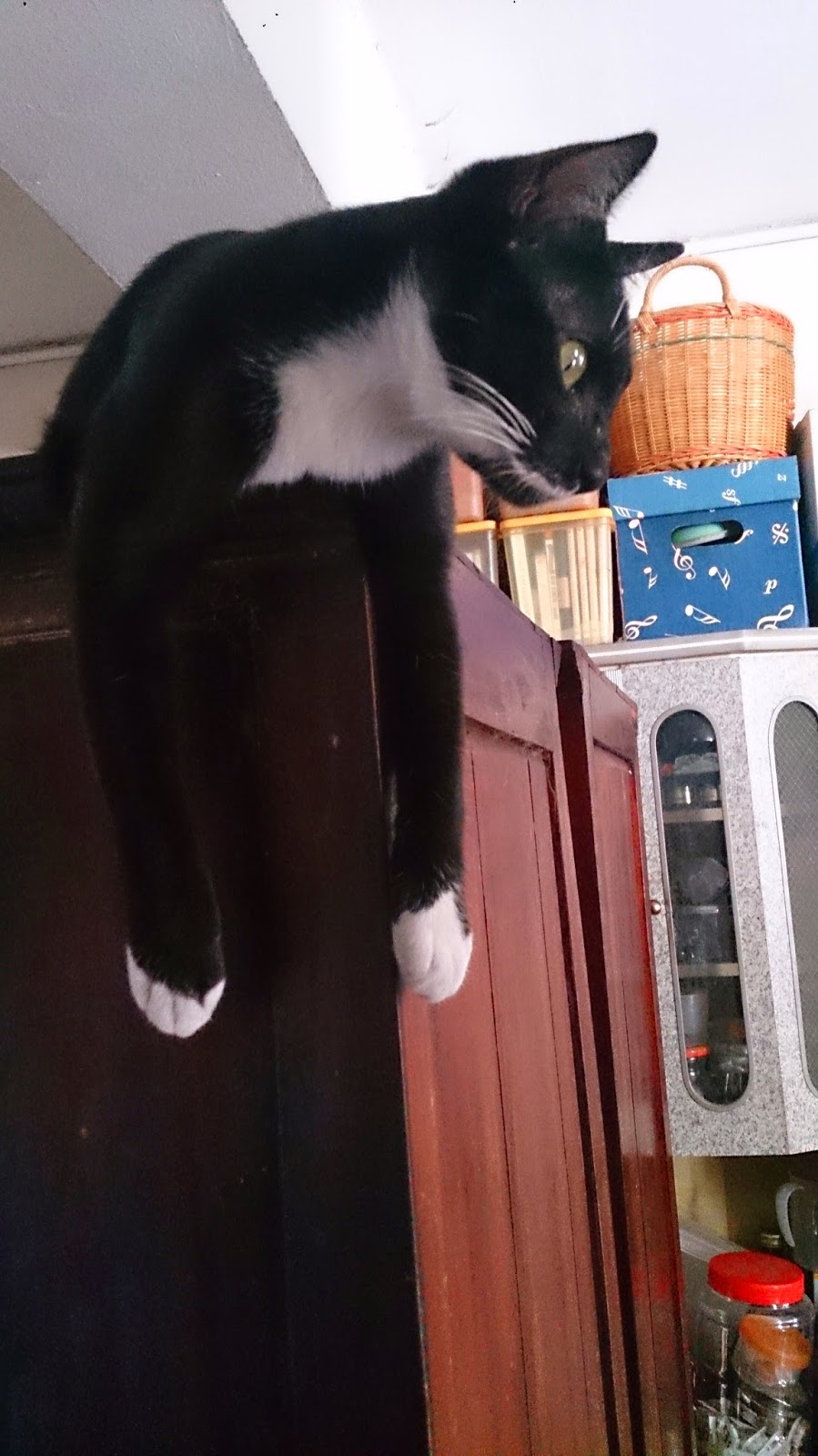
The following article, in green and blue at the end, is copied and pasted from www.cats.org.uk
Cat Flu VETERINARY GUIDE 16
Cat flu is a common illness that affects the upper respiratory tract of cats. It can be caused by a number of infectious agents, including viruses and bacteria and can be life threatening. Unfortunately, cat flu still persists, despite the availability of vaccines. The cats most severely affected include the very young, very old and those with a damaged immune system – immunosuppressed cats. Immunosuppressed cats include those infected with the feline leukaemia virus (FeLV), feline immunodeficiency virus (FIV), those with other serious illnesses and those receiving certain medication eg the drugs used in chemotherapy.
What causes cat flu?
Around 80 per cent of cases of cat flu are caused by one of two viruses, feline herpesvirus (FHV) or feline calicivirus (FCV). The viruses may both be present and once they have damaged the lining of an infected cat’s respiratory tract, the disease may be further complicated by additional bacterial infections. Other causes of cat flu include bacteria such as Chlamydophila felis – previously known as Chlamydia – and Bordetella bronchiseptica – the cause of kennel cough in dogs.
How is it spread?
The flu viruses are spread in a number of ways, including:
• direct contact with an infected cat which is showing signs of flu – the virus is present in an infected cat’s tears, saliva and nasal discharge
• sneezing can project the particles far enough to infect another nearby cat, but this route of infection is less common
• indirect contact with an infected cat’s secretions. The viruses can survive in the environment for up to a week and can be carried on clothing, people’s hands, food bowls, grooming equipment and other objects – known as fomites
• contact with a ‘carrier’ cat. These cats may be infected with and are carrying one or both of the cat flu viruses but are not showing signs of disease. During times of stress these cats may shed the virus and infect other cats.
What are the signs?
There are many signs to look out for, including:
• sneezing
• runny nose and eyes
• dribbling
• quiet and subdued behaviour
• loss of appetite
• high temperature
• a cough or loss of voice
• pneumonia
FHV can cause a severe and potentially life-threatening illness. Ulcers may form on the surface of the eye and the eyelids may become inflamed and swollen, becoming stuck to the surface of the eye. It can also lead to long-term eye complications causing pain and affecting vision and/or long-term infections following damage to the nasal passages and sinuses
FCV usually causes a milder form of cat flu. In kittens, it can cause lameness and a high temperature. In adults, sometimes the only sign of an FCV infection is painful ulcers, found on the tongue, roof of the mouth or the nose. Recently however, a more severe disease caused by FCV has been identified, termed virulent systemic disease (VSD) which is highly infectious and which has a much higher death rate (see later). FCV is also thought to be associated with feline chronic gingivostomatitis in some cats – see Veterinary Guide: Teeth and oral health.
Chlamydophila can produce a mild form of flu. Discharge and redness of the eyes is a common feature of this infection.
Bordetella causes flu-like signs like those described above but may also progress to the chest, causing a serious infection and a relatively high death rate in kittens. Cats infected with Bordetella may develop a cough.
How is it diagnosed?
A diagnosis of cat flu is mainly based on the signs the cat is displaying. Your vet may take swabs from your cat’s mouth, nose and eyes to be submitted to a laboratory where the virus or bacteria can be grown and identified.
How is it treated and managed?
Your vet may prescribe symptomatic treatment to control the signs of cat flu and good nursing care is required. Some antiviral drugs or drugs to modulate the immune system may also help to control the infection, but are not currently licensed to treat cat flu. Infectious cats are rarely hospitalised because of the risk to other cats, so nursing care is usually done at home. Management of the condition includes:
• keeping your cat quiet, warm and comfortable with easy access to his key resources, such as food, water, litter tray and a bed
• minimising stress – so keep other pets and noisy children away from the patient while he recuperates
• removing discharge from his eyes and nose with a damp piece of cotton wool
• relieving nasal congestion by placing your cat in a steamy bathroom or near to a bowl of hot water – always supervise your cat around hot water
• encouraging eating by warming food or offering a range of foods little and often, particularly smelly and palatable food such as sardines. You may need to hand-feed him. If necessary, your vet may provide a special diet which can be syringe fed
• ensuring that lots of clean, fresh drinking water is provided and your cat is encouraged to drink little and often
• treatment of any secondary bacterial infections with antibiotics
• giving prescribed medication to help loosen and break up the nasal discharge and make breathing easier
• administering eye ointments
• giving antiviral medication which may help to reduce the severity of the symptoms
• treating for an extended period with oral medication is usually required to clear infection with Chlamydophila felis – even after the signs of infection have gone – to prevent recurrence and prevent transmission to others – all cats in direct contact generally require treatment
If hospitalisation is required due to the severity of the flu, treatment may also include intravenous fluids via a drip for dehydrated cats and vitamin injections or drugs to help stimulate appetite. The infected cat may need to have a feeding tube placed if they are still reluctant to eat.
In multi-cat households it is recommended that infected cats are isolated and kept in a different room away from all noninfected cats. They should be provided with separate food bowls and litter trays and these should be disinfected with a suitable disinfectant as recommended by your vet. Healthy cats should be attended to first and separate clothing, footwear or overalls/aprons and gloves should be worn.
What does the future hold?
The majority of cats infected with FHV will recover, but this can take several weeks. Unfortunately, your cat may suffer ongoing problems, including permanent damage and inflammation of the lining of the nasal passages, eye, sinuses and airways due to inflammation and secondary bacterial infections. These infections leading to chronic rhinitis – inflammation of the nasal passages – or recurrent eye problems and may require treatment on a regular basis.
On some occasions, cats may be so severely affected by an infection that they have to have one or both eyes removed. Early treatment is vital in preventing this outcome.
In addition, all cats infected with FHV remain infected for life, shedding the virus intermittently during their lifetime. At these times – usually occurring after a stressful experience and lasting for up to two weeks – your cat will be infectious but will not necessarily show the signs of flu.
In contrast, cats are able to clear FCV after a period of time – most cats will clear the infection and no longer be infectious after a few weeks or months. A small minority may remain infected for several years.
Can I prevent cat flu?
Regular vaccination against FHV and FCV is the most effective way of reducing the risk of developing cat flu. Vaccination can start at eight to nine weeks of age in kittens, with a second dose at 12 weeks. Boosters are required at regular intervals thereafter.
Flu vaccines are not always 100 per cent effective in preventing disease altogether but will usually prevent severe disease. If, in spite of vaccination, your cat does still develop a mild form of flu it will usually be milder and may be because:
• There are many strains of FCV and vaccines may only protect against some of them
• Your cat’s immune system is overwhelmed if he is infected with a high dose of a very virulent virus
• Your cat may have other disorders affecting his immune system reducing his immune response to infection
• Your cat could already be an asymptomatic carrier of the flu viruses due to infection before vaccination
Vaccines against Chlamydophila felis and Bordetella bronchiseptica are also available, but are not usually given on a routine basis to all cats. Your vet will decide if these are necessary by evaluating your cat’s lifestyle to assess the risk of infection.
Virulent systemic disease (VSD)
The more potent disease caused by FCV which has emerged is known as virulent systemic disease (VSD). It has been identified in recent years in both the USA and UK and unfortunately has a high death rate of up to 70 per cent. Normal replication of the virus can lead to development of a virulent strain. Cats which become infected with this strain of FCV may have swelling of the face and paws, a high temperature and severe ulcers on the head, legs and feet. Jaundice – yellow gums, eyes and skin – along with bleeding from the mouth and nose may also be seen as the disease progresses. Unusually adult cats seem to be more commonly affected by this strain than kittens and even vaccinated cats can be afflicted. The VSD virus is readily transferred on people’s clothing and hands, so strict barrier nursing and isolation of affected individuals is extremely important to try and limit the spread of this fatal disease. Each outbreak occurs as a result of mutation of FCV – often due to the mixing of cats carrying different strains of FCV – and this mutation in a single cat can then cause illness in other cats. Each outbreak is a unique event and fortunately seems to naturally burn out quickly, but it can be devastating for those cats and owners affected.
I cancelled my plan to go window-shopping today because I need to observe Tam. Fortunately, other than the sneezing, she is her usual playful self and she is eating normally and there is no fever. But still just in case the sneezing gets worse, I will take her to the vet. Even though both my cats are vaccinated, I am still a little worried as perhaps a virulent strain of some virus might have mutated to conquer the available antibiotics. Even vaccinated cats can still get the flu due the reasons listed at the end of the article I pasted below. So it is good to be vigilant and to closely monitor symptoms on your pets.
Despite the sneezing, Miss Tuxedo is her usual boisterous self. This morning antics is hanging down from the bookshelf batman style.
The following article, in green and blue at the end, is copied and pasted from www.cats.org.uk
Cat Flu VETERINARY GUIDE 16
Cat flu is a common illness that affects the upper respiratory tract of cats. It can be caused by a number of infectious agents, including viruses and bacteria and can be life threatening. Unfortunately, cat flu still persists, despite the availability of vaccines. The cats most severely affected include the very young, very old and those with a damaged immune system – immunosuppressed cats. Immunosuppressed cats include those infected with the feline leukaemia virus (FeLV), feline immunodeficiency virus (FIV), those with other serious illnesses and those receiving certain medication eg the drugs used in chemotherapy.
What causes cat flu?
Around 80 per cent of cases of cat flu are caused by one of two viruses, feline herpesvirus (FHV) or feline calicivirus (FCV). The viruses may both be present and once they have damaged the lining of an infected cat’s respiratory tract, the disease may be further complicated by additional bacterial infections. Other causes of cat flu include bacteria such as Chlamydophila felis – previously known as Chlamydia – and Bordetella bronchiseptica – the cause of kennel cough in dogs.
How is it spread?
The flu viruses are spread in a number of ways, including:
• direct contact with an infected cat which is showing signs of flu – the virus is present in an infected cat’s tears, saliva and nasal discharge
• sneezing can project the particles far enough to infect another nearby cat, but this route of infection is less common
• indirect contact with an infected cat’s secretions. The viruses can survive in the environment for up to a week and can be carried on clothing, people’s hands, food bowls, grooming equipment and other objects – known as fomites
• contact with a ‘carrier’ cat. These cats may be infected with and are carrying one or both of the cat flu viruses but are not showing signs of disease. During times of stress these cats may shed the virus and infect other cats.
What are the signs?
There are many signs to look out for, including:
• sneezing
• runny nose and eyes
• dribbling
• quiet and subdued behaviour
• loss of appetite
• high temperature
• a cough or loss of voice
• pneumonia
FHV can cause a severe and potentially life-threatening illness. Ulcers may form on the surface of the eye and the eyelids may become inflamed and swollen, becoming stuck to the surface of the eye. It can also lead to long-term eye complications causing pain and affecting vision and/or long-term infections following damage to the nasal passages and sinuses
FCV usually causes a milder form of cat flu. In kittens, it can cause lameness and a high temperature. In adults, sometimes the only sign of an FCV infection is painful ulcers, found on the tongue, roof of the mouth or the nose. Recently however, a more severe disease caused by FCV has been identified, termed virulent systemic disease (VSD) which is highly infectious and which has a much higher death rate (see later). FCV is also thought to be associated with feline chronic gingivostomatitis in some cats – see Veterinary Guide: Teeth and oral health.
Chlamydophila can produce a mild form of flu. Discharge and redness of the eyes is a common feature of this infection.
Bordetella causes flu-like signs like those described above but may also progress to the chest, causing a serious infection and a relatively high death rate in kittens. Cats infected with Bordetella may develop a cough.
How is it diagnosed?
A diagnosis of cat flu is mainly based on the signs the cat is displaying. Your vet may take swabs from your cat’s mouth, nose and eyes to be submitted to a laboratory where the virus or bacteria can be grown and identified.
How is it treated and managed?
Your vet may prescribe symptomatic treatment to control the signs of cat flu and good nursing care is required. Some antiviral drugs or drugs to modulate the immune system may also help to control the infection, but are not currently licensed to treat cat flu. Infectious cats are rarely hospitalised because of the risk to other cats, so nursing care is usually done at home. Management of the condition includes:
• keeping your cat quiet, warm and comfortable with easy access to his key resources, such as food, water, litter tray and a bed
• minimising stress – so keep other pets and noisy children away from the patient while he recuperates
• removing discharge from his eyes and nose with a damp piece of cotton wool
• relieving nasal congestion by placing your cat in a steamy bathroom or near to a bowl of hot water – always supervise your cat around hot water
• encouraging eating by warming food or offering a range of foods little and often, particularly smelly and palatable food such as sardines. You may need to hand-feed him. If necessary, your vet may provide a special diet which can be syringe fed
• ensuring that lots of clean, fresh drinking water is provided and your cat is encouraged to drink little and often
• treatment of any secondary bacterial infections with antibiotics
• giving prescribed medication to help loosen and break up the nasal discharge and make breathing easier
• administering eye ointments
• giving antiviral medication which may help to reduce the severity of the symptoms
• treating for an extended period with oral medication is usually required to clear infection with Chlamydophila felis – even after the signs of infection have gone – to prevent recurrence and prevent transmission to others – all cats in direct contact generally require treatment
If hospitalisation is required due to the severity of the flu, treatment may also include intravenous fluids via a drip for dehydrated cats and vitamin injections or drugs to help stimulate appetite. The infected cat may need to have a feeding tube placed if they are still reluctant to eat.
In multi-cat households it is recommended that infected cats are isolated and kept in a different room away from all noninfected cats. They should be provided with separate food bowls and litter trays and these should be disinfected with a suitable disinfectant as recommended by your vet. Healthy cats should be attended to first and separate clothing, footwear or overalls/aprons and gloves should be worn.
What does the future hold?
The majority of cats infected with FHV will recover, but this can take several weeks. Unfortunately, your cat may suffer ongoing problems, including permanent damage and inflammation of the lining of the nasal passages, eye, sinuses and airways due to inflammation and secondary bacterial infections. These infections leading to chronic rhinitis – inflammation of the nasal passages – or recurrent eye problems and may require treatment on a regular basis.
On some occasions, cats may be so severely affected by an infection that they have to have one or both eyes removed. Early treatment is vital in preventing this outcome.
In addition, all cats infected with FHV remain infected for life, shedding the virus intermittently during their lifetime. At these times – usually occurring after a stressful experience and lasting for up to two weeks – your cat will be infectious but will not necessarily show the signs of flu.
In contrast, cats are able to clear FCV after a period of time – most cats will clear the infection and no longer be infectious after a few weeks or months. A small minority may remain infected for several years.
Can I prevent cat flu?
Regular vaccination against FHV and FCV is the most effective way of reducing the risk of developing cat flu. Vaccination can start at eight to nine weeks of age in kittens, with a second dose at 12 weeks. Boosters are required at regular intervals thereafter.
Flu vaccines are not always 100 per cent effective in preventing disease altogether but will usually prevent severe disease. If, in spite of vaccination, your cat does still develop a mild form of flu it will usually be milder and may be because:
• There are many strains of FCV and vaccines may only protect against some of them
• Your cat’s immune system is overwhelmed if he is infected with a high dose of a very virulent virus
• Your cat may have other disorders affecting his immune system reducing his immune response to infection
• Your cat could already be an asymptomatic carrier of the flu viruses due to infection before vaccination
Vaccines against Chlamydophila felis and Bordetella bronchiseptica are also available, but are not usually given on a routine basis to all cats. Your vet will decide if these are necessary by evaluating your cat’s lifestyle to assess the risk of infection.
Virulent systemic disease (VSD)
The more potent disease caused by FCV which has emerged is known as virulent systemic disease (VSD). It has been identified in recent years in both the USA and UK and unfortunately has a high death rate of up to 70 per cent. Normal replication of the virus can lead to development of a virulent strain. Cats which become infected with this strain of FCV may have swelling of the face and paws, a high temperature and severe ulcers on the head, legs and feet. Jaundice – yellow gums, eyes and skin – along with bleeding from the mouth and nose may also be seen as the disease progresses. Unusually adult cats seem to be more commonly affected by this strain than kittens and even vaccinated cats can be afflicted. The VSD virus is readily transferred on people’s clothing and hands, so strict barrier nursing and isolation of affected individuals is extremely important to try and limit the spread of this fatal disease. Each outbreak occurs as a result of mutation of FCV – often due to the mixing of cats carrying different strains of FCV – and this mutation in a single cat can then cause illness in other cats. Each outbreak is a unique event and fortunately seems to naturally burn out quickly, but it can be devastating for those cats and owners affected.
Subscribe to:
Posts (Atom)