In my opinion, wherever we are on this earth, or even on another planet in the distant future, we are supposed to co-exist with other human beings, with other creatures big and small, with the environment, with the universe. We have to learn to respect and tolerate one another even if our opinions differ.
We should observe and we should think for ourselves and not just swallow whatever that is rammed down our throats by others, be that friends, elders, bosses, families, leaders, politicians and religious clerics. More often that not, a large portion of prejudice, bigotry, slanders and even lies are pushed under our noses among other things, under the pretext of "defending" us against something. I have always taken care of myself, I do not need other people defending me for my race or my religion. I am a mongrel by the way. There is intermingling of Ceylonese blood (second generation) on my mum's side and therefore I am not a true Malay as the immigrant blood is inside me. And I am not a moron that I cannot think for myself.
A few years ago, some officers from AR came to to the training centre where I worked to conduct some talk on will-making. I was very interested in that topic because I was about to make a will myself. After all the preliminary introductions about the programme, one of the officers began to state some verses from the Quran concerning making a will in Islam. After a few minutes, he then asked the question "Kat sini tak de orang tak pakai tudung ye?" I do not wear the headscarf, not then not now. Either he didn't see me or he purposely wanted to embarrass me, the only un-scarfed female of the lot. Everybody was quiet, a lot of my colleagues in the meeting felt a little awkward I think, then he continued with the topic. With all due respect to all my lady friends who wear the hijab, if the value of an individual is so much place on how she dresses alone then that religion is a shallow one. I felt a little humiliated in that programme honestly, like I was such a sinner, but because I really wanted to know about will making I stayed on. May be also because I am the reserved type who doesn't like confrontation unless it is necessary. More because I really wanted to know about the topic actually. However my inner dialogue was like"Get lost you jerk, you are not going to defeat me by your holier than thou attitude". If I should have stood up and asked him, what relevance was my not wearing the head scarf to the programme, then perhaps another awkward situation would have followed and my temper would have flared and I would leave the session. Why not be generous, do not snub people but treat everyone courteously, even if you think that person is less religious than you because she doesn't wear the head scarf? Why not present Islam as something friendly, non-judgemental and an endearing and compelling religion? If we cannot be friendly to a fellow Muslim, how can we expand that to the rest of humanities. Later on, I did my will with Maybank actually. The cost was cheaper than AR and nobody said anything about me, going to the bank in jeans and shirt and not wearing a head scarf. This is just a small example and I like to believe that that particular official did not represent the whole of that organisation. Hopefully.
I am at times baffled by statements made by some of our ministers regarding people from different sect of Islam and I am honestly quite alarmed at the arrogance and brashness of some of the religious authorities in dealing with individuals with different opinions or in handling matters under their prerogatives. Religion is creeping into every aspect of public life when it should be a personal matter.
The following is Rumi's quote on his search for God. I intensely love this quote/poem.
I searched for God among the Christians and on the Cross and therein I found Him not.
I went into the ancient temples of idolatry; no trace of Him was there.
I entered the mountain cave of Hira and then went as far as Qandhar but God I found not.
With set purpose I fared to the summit of Mount Caucasus and found there only 'anqa's habitation.
Then I directed my search to the Kaaba, the resort of old and young; God was not there even.
Turning to philosophy I inquired about him from ibn Sina but found Him not within his range.
I fared then to the scene of the Prophet's experience of a great divine manifestation only a "two bow-lengths' distance from him" but God was not there even in that exalted court.
Finally, I looked into my own heart and there I saw Him; He was nowhere else.
Mawlana Jalaludin Rumi
I find the article below very very refreshing, even if some parts of it I do not agree. It is copied from one of the popular blogs which I follow. However I do very much hope the "extremists" meant by the writer covers all ethnicities, religious backgounds, all manner of government supporters, opposition supporters or individuals like me who do not support any political party nor aligned ourselves with any individual.
Malays Must Stand Up To The Extremists (and Malaysians too)
by Ahmad Hafidz Baharom |
June 24, 2014 2:44PM @http://www.malaysiakini.com
First and foremost, I am a third generation constitutional Malaysian Malay Muslim, as far as I can tell from my secondary school history project I did in 1996. That being said, there are those who may have a history of their ancestors and families living in this nation longer than I have.I am partially Chinese, Indian, Indonesian Malay and Malaysian Malay, which we can all say are the four biggest populations in Malaysia currently.
All I can say about this is that my parents must have taken Dr Mahathir Mohamad’s racial genetic co-mingling which he suggested in The Malay Dilemma seriously.As much as I am a Malay, I am not a supporter of UMNO, nor am I a supporter of PAS or any political party. Instead, I align myself to individuals, among them PAS’ Khalid Abdul Samad, and Mujahid Rawa (regardless of his anti-smoking crusade), DAP’s Charles Santiago and Tony Pua, PKR’s Nurul Izzah Anwar, Elizabeth Wong, Nik Nazmi Nik Ahmad, and Rafizi Ramli, and UMNO’s Saifudin Abdullah, Ahmad Husni Hanadziah and Nur Jazlan Mohamed.As a graduate of UiTM, I am thankful for what UMNO has done in the past, but that doesn’t exclude them from criticism. Nor does it exclude UiTM from criticism. As such, I don’t find an insult to UMNO as an insult to myself as a Malay, nor do I see urging UiTM to be opened up to non-bumiputeras as an insult to myself.
Similarly, I do not find it taboo for a non-Muslim to wish me salam, or to use Islamic phrases. This is because I see it as a positive, as them trying to emulate our culture instead of somehow seeing it as a threat against my religion. In other words, I am not a paranoid. In the past year or so, we have somehow seen that any insult to UMNO, Ikaan Muslimin Malaysia (Isma), having Iban language Bibles, urging the reining in of religious authorities, all of this as an insult to Malays.
UMNO is not a representation of all the Malays in Malaysia. The fact that they lost Shah Alam in the last two general elections is solid proof of it. Mind you, we have a more than 90 percent Malay population in this parliamentary district. Isma’s president, contrary to his wife’s belief, is not the representative of all Malays. After all, if he thinks the Chinese are trespassers, then he is equally saying I myself am the product of a trespassing ancestor.
A Penang assemblyperson calling UMNO ‘celaka’ is also not an insult to me, because I have seen students right out of UiTM who just got their first jobs giving out the same expletive remarks when they read news coverage of the Auditor-General’s Report. And by the way, these were former BN Youth Volunteers during the 2013 general election.
I am not a traitor to HRH Sultan Sharafuddin Idris Shah for thinking that both the Selangor Islamic Religious Council (Mais) and the Selangor Islamic Religious Department (Jais) are in the wrong and have totally lost the plot by seizing Bibles and having fake ex-Christians hold a talk at UiTM, regardless of what Negri Sembilan Perkasa suggests. And if they think they need to behead me for this, I suggest they check in with the His HRH Sultan of Selangor to use his royal courtyard for the guillotine.
I believe the Malays have to now take a stand against all these extreme views, and voice it out as ardently as possible; that we are no longer represented by extremists. Now is the time for the Malays to take a stand and tell those in charge to either stop it, or face the consequences of misrepresenting us to the entire world.
It is time to take legal action against our extremists to gag them from making unwarranted statements that tarnish the image of the Malay race. If not, then the greatest insult to the Malays would be the insult we do to ourselves by letting the voice of the loud few destroy whatever pride we have left in ourselves as a people, as a community, as a majority in this country.
Saturday, 28 June 2014

Wednesday, 25 June 2014
Cat Flu
My little young lady Tam is sneezing every now and then ever since yesterday. Before that she was coughing a little. I am a bit worried, what with all the bad news around. Nine of Nizam and Ain's cats passed away because of the flu recently. Must be hard on them loosing nine furry kids in a short span of time. Today my niece Syikin messaged me that a vet in Ipoh who was keeping data, informed her that in and around Ipoh about 600 cats perished because of the cat flu since early June.
I cancelled my plan to go window-shopping today because I need to observe Tam. Fortunately, other than the sneezing, she is her usual playful self and she is eating normally and there is no fever. But still just in case the sneezing gets worse, I will take her to the vet. Even though both my cats are vaccinated, I am still a little worried as perhaps a virulent strain of some virus might have mutated to conquer the available antibiotics. Even vaccinated cats can still get the flu due the reasons listed at the end of the article I pasted below. So it is good to be vigilant and to closely monitor symptoms on your pets.
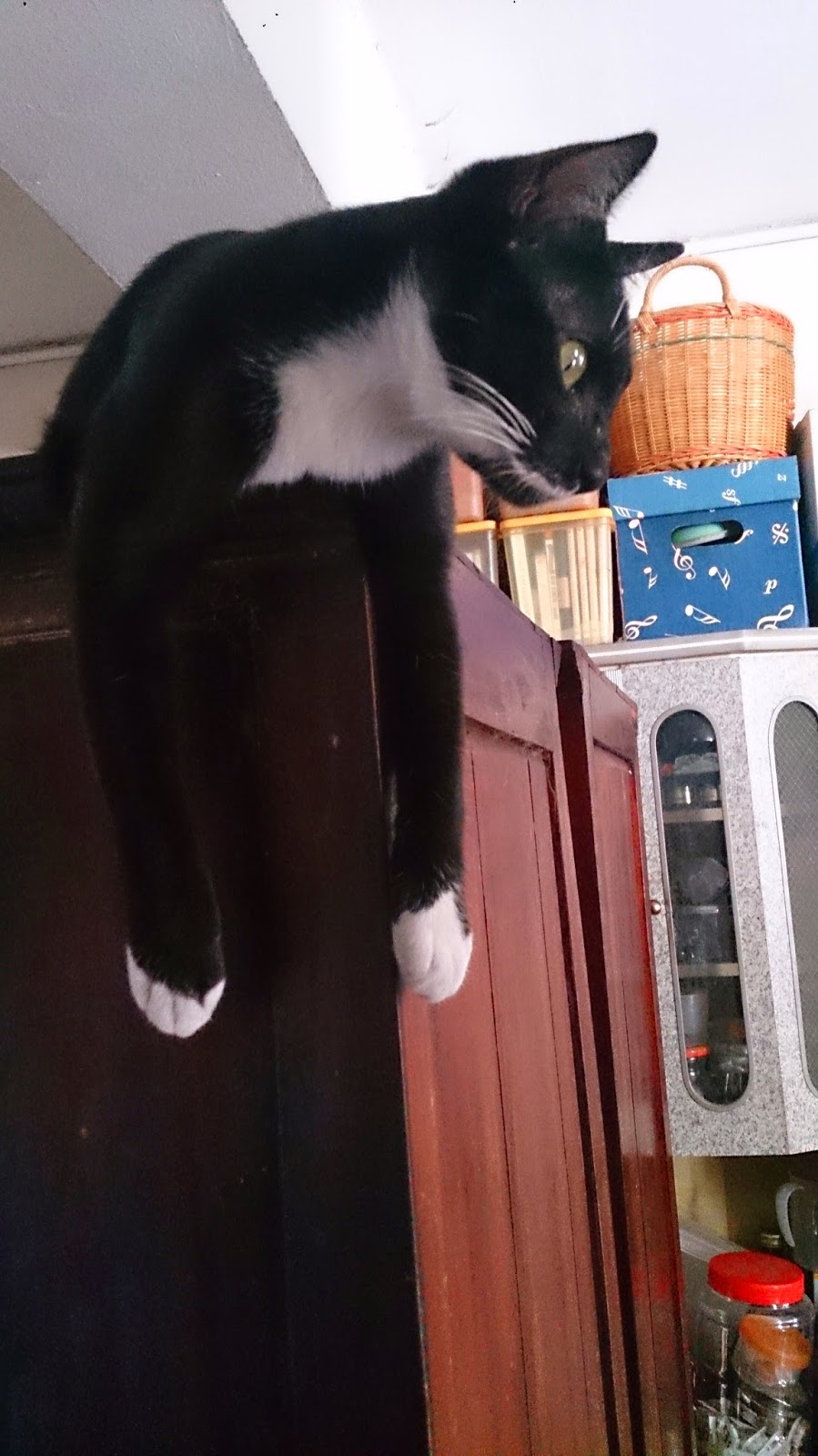
Despite the sneezing, Miss Tuxedo is her usual boisterous self. This morning antics is hanging down from the bookshelf batman style.

The following article, in green and blue at the end, is copied and pasted from www.cats.org.uk
Cat Flu VETERINARY GUIDE 16
Cat flu is a common illness that affects the upper respiratory tract of cats. It can be caused by a number of infectious agents, including viruses and bacteria and can be life threatening. Unfortunately, cat flu still persists, despite the availability of vaccines. The cats most severely affected include the very young, very old and those with a damaged immune system – immunosuppressed cats. Immunosuppressed cats include those infected with the feline leukaemia virus (FeLV), feline immunodeficiency virus (FIV), those with other serious illnesses and those receiving certain medication eg the drugs used in chemotherapy.
What causes cat flu?
Around 80 per cent of cases of cat flu are caused by one of two viruses, feline herpesvirus (FHV) or feline calicivirus (FCV). The viruses may both be present and once they have damaged the lining of an infected cat’s respiratory tract, the disease may be further complicated by additional bacterial infections. Other causes of cat flu include bacteria such as Chlamydophila felis – previously known as Chlamydia – and Bordetella bronchiseptica – the cause of kennel cough in dogs.
How is it spread?
The flu viruses are spread in a number of ways, including:
• direct contact with an infected cat which is showing signs of flu – the virus is present in an infected cat’s tears, saliva and nasal discharge
• sneezing can project the particles far enough to infect another nearby cat, but this route of infection is less common
• indirect contact with an infected cat’s secretions. The viruses can survive in the environment for up to a week and can be carried on clothing, people’s hands, food bowls, grooming equipment and other objects – known as fomites
• contact with a ‘carrier’ cat. These cats may be infected with and are carrying one or both of the cat flu viruses but are not showing signs of disease. During times of stress these cats may shed the virus and infect other cats.
What are the signs?
There are many signs to look out for, including:
• sneezing
• runny nose and eyes
• dribbling
• quiet and subdued behaviour
• loss of appetite
• high temperature
• a cough or loss of voice
• pneumonia
FHV can cause a severe and potentially life-threatening illness. Ulcers may form on the surface of the eye and the eyelids may become inflamed and swollen, becoming stuck to the surface of the eye. It can also lead to long-term eye complications causing pain and affecting vision and/or long-term infections following damage to the nasal passages and sinuses
FCV usually causes a milder form of cat flu. In kittens, it can cause lameness and a high temperature. In adults, sometimes the only sign of an FCV infection is painful ulcers, found on the tongue, roof of the mouth or the nose. Recently however, a more severe disease caused by FCV has been identified, termed virulent systemic disease (VSD) which is highly infectious and which has a much higher death rate (see later). FCV is also thought to be associated with feline chronic gingivostomatitis in some cats – see Veterinary Guide: Teeth and oral health.
Chlamydophila can produce a mild form of flu. Discharge and redness of the eyes is a common feature of this infection.
Bordetella causes flu-like signs like those described above but may also progress to the chest, causing a serious infection and a relatively high death rate in kittens. Cats infected with Bordetella may develop a cough.
How is it diagnosed?
A diagnosis of cat flu is mainly based on the signs the cat is displaying. Your vet may take swabs from your cat’s mouth, nose and eyes to be submitted to a laboratory where the virus or bacteria can be grown and identified.
How is it treated and managed?
Your vet may prescribe symptomatic treatment to control the signs of cat flu and good nursing care is required. Some antiviral drugs or drugs to modulate the immune system may also help to control the infection, but are not currently licensed to treat cat flu. Infectious cats are rarely hospitalised because of the risk to other cats, so nursing care is usually done at home. Management of the condition includes:
• keeping your cat quiet, warm and comfortable with easy access to his key resources, such as food, water, litter tray and a bed
• minimising stress – so keep other pets and noisy children away from the patient while he recuperates
• removing discharge from his eyes and nose with a damp piece of cotton wool
• relieving nasal congestion by placing your cat in a steamy bathroom or near to a bowl of hot water – always supervise your cat around hot water
• encouraging eating by warming food or offering a range of foods little and often, particularly smelly and palatable food such as sardines. You may need to hand-feed him. If necessary, your vet may provide a special diet which can be syringe fed
• ensuring that lots of clean, fresh drinking water is provided and your cat is encouraged to drink little and often
• treatment of any secondary bacterial infections with antibiotics
• giving prescribed medication to help loosen and break up the nasal discharge and make breathing easier
• administering eye ointments
• giving antiviral medication which may help to reduce the severity of the symptoms
• treating for an extended period with oral medication is usually required to clear infection with Chlamydophila felis – even after the signs of infection have gone – to prevent recurrence and prevent transmission to others – all cats in direct contact generally require treatment
If hospitalisation is required due to the severity of the flu, treatment may also include intravenous fluids via a drip for dehydrated cats and vitamin injections or drugs to help stimulate appetite. The infected cat may need to have a feeding tube placed if they are still reluctant to eat.
In multi-cat households it is recommended that infected cats are isolated and kept in a different room away from all noninfected cats. They should be provided with separate food bowls and litter trays and these should be disinfected with a suitable disinfectant as recommended by your vet. Healthy cats should be attended to first and separate clothing, footwear or overalls/aprons and gloves should be worn.
What does the future hold?
The majority of cats infected with FHV will recover, but this can take several weeks. Unfortunately, your cat may suffer ongoing problems, including permanent damage and inflammation of the lining of the nasal passages, eye, sinuses and airways due to inflammation and secondary bacterial infections. These infections leading to chronic rhinitis – inflammation of the nasal passages – or recurrent eye problems and may require treatment on a regular basis.
On some occasions, cats may be so severely affected by an infection that they have to have one or both eyes removed. Early treatment is vital in preventing this outcome.
In addition, all cats infected with FHV remain infected for life, shedding the virus intermittently during their lifetime. At these times – usually occurring after a stressful experience and lasting for up to two weeks – your cat will be infectious but will not necessarily show the signs of flu.
In contrast, cats are able to clear FCV after a period of time – most cats will clear the infection and no longer be infectious after a few weeks or months. A small minority may remain infected for several years.
Can I prevent cat flu?
Regular vaccination against FHV and FCV is the most effective way of reducing the risk of developing cat flu. Vaccination can start at eight to nine weeks of age in kittens, with a second dose at 12 weeks. Boosters are required at regular intervals thereafter.
Flu vaccines are not always 100 per cent effective in preventing disease altogether but will usually prevent severe disease. If, in spite of vaccination, your cat does still develop a mild form of flu it will usually be milder and may be because:
• There are many strains of FCV and vaccines may only protect against some of them
• Your cat’s immune system is overwhelmed if he is infected with a high dose of a very virulent virus
• Your cat may have other disorders affecting his immune system reducing his immune response to infection
• Your cat could already be an asymptomatic carrier of the flu viruses due to infection before vaccination
Vaccines against Chlamydophila felis and Bordetella bronchiseptica are also available, but are not usually given on a routine basis to all cats. Your vet will decide if these are necessary by evaluating your cat’s lifestyle to assess the risk of infection.
Virulent systemic disease (VSD)
The more potent disease caused by FCV which has emerged is known as virulent systemic disease (VSD). It has been identified in recent years in both the USA and UK and unfortunately has a high death rate of up to 70 per cent. Normal replication of the virus can lead to development of a virulent strain. Cats which become infected with this strain of FCV may have swelling of the face and paws, a high temperature and severe ulcers on the head, legs and feet. Jaundice – yellow gums, eyes and skin – along with bleeding from the mouth and nose may also be seen as the disease progresses. Unusually adult cats seem to be more commonly affected by this strain than kittens and even vaccinated cats can be afflicted. The VSD virus is readily transferred on people’s clothing and hands, so strict barrier nursing and isolation of affected individuals is extremely important to try and limit the spread of this fatal disease. Each outbreak occurs as a result of mutation of FCV – often due to the mixing of cats carrying different strains of FCV – and this mutation in a single cat can then cause illness in other cats. Each outbreak is a unique event and fortunately seems to naturally burn out quickly, but it can be devastating for those cats and owners affected.
I cancelled my plan to go window-shopping today because I need to observe Tam. Fortunately, other than the sneezing, she is her usual playful self and she is eating normally and there is no fever. But still just in case the sneezing gets worse, I will take her to the vet. Even though both my cats are vaccinated, I am still a little worried as perhaps a virulent strain of some virus might have mutated to conquer the available antibiotics. Even vaccinated cats can still get the flu due the reasons listed at the end of the article I pasted below. So it is good to be vigilant and to closely monitor symptoms on your pets.
Despite the sneezing, Miss Tuxedo is her usual boisterous self. This morning antics is hanging down from the bookshelf batman style.
The following article, in green and blue at the end, is copied and pasted from www.cats.org.uk
Cat Flu VETERINARY GUIDE 16
Cat flu is a common illness that affects the upper respiratory tract of cats. It can be caused by a number of infectious agents, including viruses and bacteria and can be life threatening. Unfortunately, cat flu still persists, despite the availability of vaccines. The cats most severely affected include the very young, very old and those with a damaged immune system – immunosuppressed cats. Immunosuppressed cats include those infected with the feline leukaemia virus (FeLV), feline immunodeficiency virus (FIV), those with other serious illnesses and those receiving certain medication eg the drugs used in chemotherapy.
What causes cat flu?
Around 80 per cent of cases of cat flu are caused by one of two viruses, feline herpesvirus (FHV) or feline calicivirus (FCV). The viruses may both be present and once they have damaged the lining of an infected cat’s respiratory tract, the disease may be further complicated by additional bacterial infections. Other causes of cat flu include bacteria such as Chlamydophila felis – previously known as Chlamydia – and Bordetella bronchiseptica – the cause of kennel cough in dogs.
How is it spread?
The flu viruses are spread in a number of ways, including:
• direct contact with an infected cat which is showing signs of flu – the virus is present in an infected cat’s tears, saliva and nasal discharge
• sneezing can project the particles far enough to infect another nearby cat, but this route of infection is less common
• indirect contact with an infected cat’s secretions. The viruses can survive in the environment for up to a week and can be carried on clothing, people’s hands, food bowls, grooming equipment and other objects – known as fomites
• contact with a ‘carrier’ cat. These cats may be infected with and are carrying one or both of the cat flu viruses but are not showing signs of disease. During times of stress these cats may shed the virus and infect other cats.
What are the signs?
There are many signs to look out for, including:
• sneezing
• runny nose and eyes
• dribbling
• quiet and subdued behaviour
• loss of appetite
• high temperature
• a cough or loss of voice
• pneumonia
FHV can cause a severe and potentially life-threatening illness. Ulcers may form on the surface of the eye and the eyelids may become inflamed and swollen, becoming stuck to the surface of the eye. It can also lead to long-term eye complications causing pain and affecting vision and/or long-term infections following damage to the nasal passages and sinuses
FCV usually causes a milder form of cat flu. In kittens, it can cause lameness and a high temperature. In adults, sometimes the only sign of an FCV infection is painful ulcers, found on the tongue, roof of the mouth or the nose. Recently however, a more severe disease caused by FCV has been identified, termed virulent systemic disease (VSD) which is highly infectious and which has a much higher death rate (see later). FCV is also thought to be associated with feline chronic gingivostomatitis in some cats – see Veterinary Guide: Teeth and oral health.
Chlamydophila can produce a mild form of flu. Discharge and redness of the eyes is a common feature of this infection.
Bordetella causes flu-like signs like those described above but may also progress to the chest, causing a serious infection and a relatively high death rate in kittens. Cats infected with Bordetella may develop a cough.
How is it diagnosed?
A diagnosis of cat flu is mainly based on the signs the cat is displaying. Your vet may take swabs from your cat’s mouth, nose and eyes to be submitted to a laboratory where the virus or bacteria can be grown and identified.
How is it treated and managed?
Your vet may prescribe symptomatic treatment to control the signs of cat flu and good nursing care is required. Some antiviral drugs or drugs to modulate the immune system may also help to control the infection, but are not currently licensed to treat cat flu. Infectious cats are rarely hospitalised because of the risk to other cats, so nursing care is usually done at home. Management of the condition includes:
• keeping your cat quiet, warm and comfortable with easy access to his key resources, such as food, water, litter tray and a bed
• minimising stress – so keep other pets and noisy children away from the patient while he recuperates
• removing discharge from his eyes and nose with a damp piece of cotton wool
• relieving nasal congestion by placing your cat in a steamy bathroom or near to a bowl of hot water – always supervise your cat around hot water
• encouraging eating by warming food or offering a range of foods little and often, particularly smelly and palatable food such as sardines. You may need to hand-feed him. If necessary, your vet may provide a special diet which can be syringe fed
• ensuring that lots of clean, fresh drinking water is provided and your cat is encouraged to drink little and often
• treatment of any secondary bacterial infections with antibiotics
• giving prescribed medication to help loosen and break up the nasal discharge and make breathing easier
• administering eye ointments
• giving antiviral medication which may help to reduce the severity of the symptoms
• treating for an extended period with oral medication is usually required to clear infection with Chlamydophila felis – even after the signs of infection have gone – to prevent recurrence and prevent transmission to others – all cats in direct contact generally require treatment
If hospitalisation is required due to the severity of the flu, treatment may also include intravenous fluids via a drip for dehydrated cats and vitamin injections or drugs to help stimulate appetite. The infected cat may need to have a feeding tube placed if they are still reluctant to eat.
In multi-cat households it is recommended that infected cats are isolated and kept in a different room away from all noninfected cats. They should be provided with separate food bowls and litter trays and these should be disinfected with a suitable disinfectant as recommended by your vet. Healthy cats should be attended to first and separate clothing, footwear or overalls/aprons and gloves should be worn.
What does the future hold?
The majority of cats infected with FHV will recover, but this can take several weeks. Unfortunately, your cat may suffer ongoing problems, including permanent damage and inflammation of the lining of the nasal passages, eye, sinuses and airways due to inflammation and secondary bacterial infections. These infections leading to chronic rhinitis – inflammation of the nasal passages – or recurrent eye problems and may require treatment on a regular basis.
On some occasions, cats may be so severely affected by an infection that they have to have one or both eyes removed. Early treatment is vital in preventing this outcome.
In addition, all cats infected with FHV remain infected for life, shedding the virus intermittently during their lifetime. At these times – usually occurring after a stressful experience and lasting for up to two weeks – your cat will be infectious but will not necessarily show the signs of flu.
In contrast, cats are able to clear FCV after a period of time – most cats will clear the infection and no longer be infectious after a few weeks or months. A small minority may remain infected for several years.
Can I prevent cat flu?
Regular vaccination against FHV and FCV is the most effective way of reducing the risk of developing cat flu. Vaccination can start at eight to nine weeks of age in kittens, with a second dose at 12 weeks. Boosters are required at regular intervals thereafter.
Flu vaccines are not always 100 per cent effective in preventing disease altogether but will usually prevent severe disease. If, in spite of vaccination, your cat does still develop a mild form of flu it will usually be milder and may be because:
• There are many strains of FCV and vaccines may only protect against some of them
• Your cat’s immune system is overwhelmed if he is infected with a high dose of a very virulent virus
• Your cat may have other disorders affecting his immune system reducing his immune response to infection
• Your cat could already be an asymptomatic carrier of the flu viruses due to infection before vaccination
Vaccines against Chlamydophila felis and Bordetella bronchiseptica are also available, but are not usually given on a routine basis to all cats. Your vet will decide if these are necessary by evaluating your cat’s lifestyle to assess the risk of infection.
Virulent systemic disease (VSD)
The more potent disease caused by FCV which has emerged is known as virulent systemic disease (VSD). It has been identified in recent years in both the USA and UK and unfortunately has a high death rate of up to 70 per cent. Normal replication of the virus can lead to development of a virulent strain. Cats which become infected with this strain of FCV may have swelling of the face and paws, a high temperature and severe ulcers on the head, legs and feet. Jaundice – yellow gums, eyes and skin – along with bleeding from the mouth and nose may also be seen as the disease progresses. Unusually adult cats seem to be more commonly affected by this strain than kittens and even vaccinated cats can be afflicted. The VSD virus is readily transferred on people’s clothing and hands, so strict barrier nursing and isolation of affected individuals is extremely important to try and limit the spread of this fatal disease. Each outbreak occurs as a result of mutation of FCV – often due to the mixing of cats carrying different strains of FCV – and this mutation in a single cat can then cause illness in other cats. Each outbreak is a unique event and fortunately seems to naturally burn out quickly, but it can be devastating for those cats and owners affected.
Saturday, 21 June 2014
My Bits of Heaven on Earth
Ladies and gentlemen, we felines tend to be meticulous about our cleanliness. Let me show you how I clean my back paw, while laying down, comfortably curled up in the old plastic basin in the backyard. Photos are taken by Wan Nyah who is fascinated by my grooming. Actually she is fascinated by whatever I do or whatever Mickey does ha ha ha. I think Wan Nyah belongs to me and Mickey and not the other way round!
 |
| We felines are famous for our fastidiousness about cleanliness |
 |
| First of all, check your heel. Ensure that it is clean |
 |
| Then, if you are a tuxedo, like me, check your socks. The socks are flagship icons for tuxedos like us. |
 |
| Clean properly |
 |
| Don't forget in-between the toes. You might need to use your teeth there. |
 |
| Then examine your back paw again. Ensure that you it is really clean |
 |
| Oops...interruption! Hi wan nyah |
 |
| All that cleaning makes me a little tired |
 |
| Clean the other paws later. Need a nap first. |
The Book Thief by Markus Zusak

Missing A Movie At The Cineplex
I watched The Book Thief DVD three times. How did I missed this movie in the theatres? Probably because it wasn't shown at my regular cinema TGV Bukit Raja. Cinemas must have some form of gauge to screen movies that will be watched by the movie-buffs of the particular locality. Or simply, if they think not many people will watch it, then just don't screen it. To be very frank, I am a little fixated on stories about children having to go through a lot of hardships in their formative years, whether in the form of books or movies. Perhaps a certain part of me finds its identity in these stories, perhaps I am a little too sentimental, perhaps both. Further more, the central character in The Book Thief is a young girl who has a natural inclination towards reading and writing, albeit being able to read only at the age of ten, after being coached at home by her foster father.
I loved the movie but I loved the book much more.
About The Author
Markus Zusak is an Australian writer and was born in Sydney in 1975. He is of Austrian-German parentage and his parents migrated to Australia in the late 1950s. Zusak is a very successful writer and has won many literary awards in the young adult literature category, especially with two of his books The Messenger and The Book Thief. The Book Thief is perhaps the most successful of Zusak's writing and was published in 2005. The book has been translated into almost 40 languages and had held the number one position on The New York Times and Amazon.com bestseller list for quite some time. In 2013 The Book Thief was adapted into a movie of the same name starring Geoffrey Rush, Emily Watson and Sophie Nelisse.
I keep surfing the net to find out if somehow there is a link between the author and the story. Perhaps Zusak wrote the story based on the experience of his parents or grandparents. What I found is pasted below in green.
Zusak was born to an Austrian father and a German mother, both of whom experienced World War II firsthand in their native countries. Zusak has stated that The Book Thief was unlike anything he had written before and largely inspired by stories his parents told him as a child about wartime Munich and Vienna. Zusak has specifically singled out two stories his mother told him, one of the bombing of Munich, and one of Jews being marched through Zusak's mother's town on their way to the Dachau concentration camp.
Like The Book Thief's character of Hans Hubermann, Zusak's father was a house painter, and at an early age Zusak wanted to be a house painter as well. Zusak began writing as a teenager, and citedThe Old Man and the Sea and What's Eating Gilbert Grape as inspirations. Zusak's sixth novel, a young adult fiction titled Bridge of Clay, is to be published in November 2009.
The Book Thief
The Book Thief is about a young German girl named Liesel Meminger. In fact the whole book is mainly about Liesel Meminger's life between 1939 and 1943. In this story, the narrator is Death. I thought it is a bit morbid at first. It is January 1939 in a bitterly cold Nazi Germany and Liesel is soon approaching her tenth birthday. Liesel, her six-year-old brother Werner and their mother are on a train journey to Munich. Along the way Werner died and has to be buried in a cemetery alongside the railway track. As Liesel and her mother are about to leave the cemetery, a book falls out from one of the grave diggers coat pocket and Liesel picks it up and hide it in her clothing. Liesel is later taken on a car journey by Frau Heinrich to a fictional town of Molching, very near Munich to be handed over to her new foster parents. Her mother herself is continuing her journey to another place, perhaps to be rounded up by the Nazi SS men and further on to the concentration camps. Both of Liesel biological parents are Communist Party members which Hitler despises as much as the Jews, blacks or any other categories of humanities which is deemed not of the "pure Aryan race" or could somehow place the mighty Germans in jeopardy.
In Molching Liesel becomes the new daughter to the elderly couple Hans and Rosa Hubermann. Hans' gentle demeanour and his accordion playing quickly win Liesel over. It was Hans who teaches her the alphabets and how to read. Liesel is one of those children where a love of reading comes naturally and she is good with her "words" too. Together foster father and daughter read the book that was dropped by the grave digger at Liesel brother's funeral entitled "The Grave Digger's Handbook". Rosa Hubermann is a kind-hearted woman hidden beneath a witch exterior of loudness and constant swearing and scolding. Liesel is befriended by her twelve-year-old next door neighbour Rudy Steiner who becomes her partner in book and food thievery. It was a difficult time for most people in Molching. Hans is a house painter who finds himself out of work most of the time. Rosa supplemented the family's income by doing the laundry for the wealthy people of Molching, including the Mayor and his wife Ilsa Hermann.
A few months into her life in Molching, Liesel, Hans Hubermann, Rudy and Rudy's father Alex Steiner go to a gathering celebrating Hitler's birthday. Part of the celebration is a bonfire to burn books. When the ceremony is over Liesel picks up a partially burned book from the bonfire and hide it under her coat. It just happens that Ilsa Hermann was leaving with her husband and she sees Liesel taking the smouldering book. It was around this time too, Liesel learns the truth that her real mother has disappeared and is not coming back for her anymore. Liesel hates the Fuhrer as she begins to understand the Fuhrer's role in all these events.
Situation in Molching is getting more difficult, with work shortages and food shortages too. Jews are being rounded over and taken into custody, their properties being confiscated, their shops and businesses being destroyed.
Hans Hubermann was a soldier in WWI. He became friends with a German Jew by the name of Erik Vandenburg during that time. Erik somehow saved Hans life. After the war Hans promised Erik's widow that if ever she or her son need any help in future, he promised to help them. Erik's son Max Vandenburg enlists the help of his friend to contact Hans and to ask Hans to hide him in his house as Jews are being rounded and prosecuted in Germany. Hans agrees and one night Max arrives at Hans residence, tired, weak, almost at death's door. The Hubermanns hide him in their basement and nurse him back to health. It is not easy for the family, as the punishment for hiding a Jew will be the same as being a Jew themselves. So Max lives in the basement, even when the Hubermanns biological children Hans Junior and Trudy come home for Christmas. Liesel becomes a friend to the 22-year-old Max. Max asks Liesel to describe the outside weather to him everyday using her own words. He encourages Liesel to express herself in her own words verbally or in writing.
While picking up or delivering laundry done by her foster mother, Liesel develops some sort of friendship with the mayor's wife Ilsa Hermann. Frau Herman allows Liesel to read in the library in her home every time Liesel goes there. Ilsa Hermann knows Liesel's love of books and reading when she witnessed Liesel picking up a partly burned book from the bonfire on Hitler's birthday. Perhaps Ilsa Hermann feels a strong connection with Liesel as her own son who is lost in the ongoing war also very much loves to read.
When Max Vandenburg falls sick in the basement, Liesel reads to him. She steals books from Ilsa Hermann's library. She does not go there anymore as the Mayor's wife stops engaging Liesel foster mother to do her laundry. One day the SS comes to check their basement, checking for its suitability as an air raid shelter. It is by sheer luck that the SS does not discover Max under the basement stairs being very sick.
Liesel begins to read aloud in the basement of her neighbour on Himmel Street, which serves as an air-raid shelter, every time the Himmel Street community is there sheltering from the bomb drops. People begins to like her reading as it tends to calm them as they focus on the story Liesel narrates. In fact one of the Hubermann's neighbour, Frau Holtzapfel begins asking Liesel to come to her house on a regular basis to read to her. For that chore, Liesel is paid with whatever foodstuffs Frau Holtzapfel has at that time. Liesel's reading must be something very compelling as Frau Holtzapfel is actually not very neighbourly with Rosa Hubermann. She used to spit at the Hubermann's front door every time she passes by.
After Max recovers from his sickness, he decides to leave the Hubermanns for fear of endangering their lives. Max encourages Liesel to write as he says he will be present always in the words written by Liesel. A few weeks after that Hans Hubermann receives a letter informing him of being conscripted into the German army despite his age. Liesel and the outwardly tough Rosa are very sad about having to let him go. While Hans is away, Liesel witnesses the parade of Jews being marched away onto Dachau where one of the concentration camps is situated. Liesel breaks into the line of Jews searching for Max Vandenbug and gets thrown down by the soldiers.
A few months later however, Hans Hubermann comes home after being injured slightly in the leg. He once again cheated death as he changed seat with another younger soldier who is killed when their army truck overturned. Liesel remembers Max advice and she starts writing the story of the book thief. One night after completing her story, Liesel falls asleep in the basement. There is no air-raid sirens but bombs begin falling on Himmel Street while the inhabitants are sleeping. In the morning, Liesel is discovered safe in her basement. Hans Hubermann, Rosa Hubermann, Rudy Steiner, Rudy's mother and siblings all perished in that bombing. Liesel runs and hugs Ilsa Hermann where the latter arrives at the scene and she drops the book that she had written. It was then that Death picks up the book and learns of her story.
Two years after the bombing of Himmel Street, Max Vandenburg came to meet Liesel who by that time is staying with Rudy's father Alex Steiner.
Death then tells the story of him coming to get Liesel when she is in her nineties. After all, as Death puts it, everybody dies. By then she had made good of her ninety years, she had had a good life. She migrated to Australia, became a famous writer, got married, has three children and a few grandchildren. Death is overwhelms by humans who can be beautiful and can also be hideous in nature.
 |
| The last page of the book |
Saturday, 17 May 2014
A Cool Saturday
The rain this morning was indeed cooling and comforting after the awful heat of Thursday and Friday. On Thursday when I entered my car that had been parked for about half a day, the temperature reading was 39ºC. I guessed not a very uncommon reading nowadays. It is only May and we haven't really reached the peak of the dry season yet. I just wonder how hot it will be in July and August, what with the El Nino expected to cause a lot of weather havoc. Hopefully Selangor will not have to go through water rationing again. Somehow I am apprehensive about believing that the water problems will not happen again.
My two cats are lazily stretching on their favourite ports, Mickey on the boxes that I have arranged with at least two layers of blankets outside on the porch and Tam on the boxes filled with books that I had topped with about one inch of old newspapers near the front door. They keep changing places though. After sometime Mickey jumped up on the top of the book shelves and Tam moved to Mickey's spot. Later again Mickey went upstairs to his favourite perch on top of my boxes of odds and ends. However not before he stopped a few minutes in front of Comot's cage, hissing and growling to intimidate the kitten. Comot is the little orphan kitten I am rescuing and finding a home for later on. After a little while Tam too went upstairs to perform her own daily inspection of Comot.
Even if she is just about seven months old herself, Tam is rather cool with her scrutiny of the little kitten. She doesn't hiss or growl anymore when Comot is near. She sits in front of the cage staring at Comot for a while. Then she jumps up on top of the cage and looks down on Comot, almost inviting her to play together, even if Comot is inside the cage. Actually that was Mickey did when Tam was in the cage, during the first few weeks that I took her in.
Nowadays, on days that I do not have my physiotherapy session, part of my morning will be spent scanning and reading through some of the local socio-political blogs. I think I have become a little addicted to them. Among my favourites are Syed Outside The Box, The Scribe A.Kadir Jasin, Aspan Alias, Din Merican, Helen Ang, Apanama, Articulation, No Holds Barred RPK, Kassim Ahmad, Rantings by MM and of course the well known Rocky's Bru by the veteran Ahiruddin Attan. Articulation has stopped writing for quite some time, I don't know why and Rocky has gone riding to the Middle East I heard and has put blogging on hold for a while I supposed.
It is while reading these blogs that I came across the writings of the famous Mariam Mokhtar, the columnist, as far as I know, for the Malaysiakini and Free Malaysia Today portals. I think Ms Mariam is very clear, analytical and articulate in her writings and she commands the English language very very comfortably. I make a point of reading all her articles even though I do not agree with many of her ideas. On the other hand, many of her points I think are truthful and spot-on. I myself very much believed that being truthful to the the reality of our situation is of paramount importance if we are sincere about improving ourselves. If we cannot be truthful to ourselves, the majority of the Malays as a community will always be lagging behind. We can be in self-denial mode, but sooner or later reality will catch up with us.
Pasted below are two of Mariam's articles, the first of which appeared in Malaysiakini in early 2010 and the other in Free Malaysia Today in late 2013.
My two cats are lazily stretching on their favourite ports, Mickey on the boxes that I have arranged with at least two layers of blankets outside on the porch and Tam on the boxes filled with books that I had topped with about one inch of old newspapers near the front door. They keep changing places though. After sometime Mickey jumped up on the top of the book shelves and Tam moved to Mickey's spot. Later again Mickey went upstairs to his favourite perch on top of my boxes of odds and ends. However not before he stopped a few minutes in front of Comot's cage, hissing and growling to intimidate the kitten. Comot is the little orphan kitten I am rescuing and finding a home for later on. After a little while Tam too went upstairs to perform her own daily inspection of Comot.
Even if she is just about seven months old herself, Tam is rather cool with her scrutiny of the little kitten. She doesn't hiss or growl anymore when Comot is near. She sits in front of the cage staring at Comot for a while. Then she jumps up on top of the cage and looks down on Comot, almost inviting her to play together, even if Comot is inside the cage. Actually that was Mickey did when Tam was in the cage, during the first few weeks that I took her in.
 |
| What is this Comot kitten doing in my cage? |
 |
| Let me see you kitten. Are you scared of me? |
 |
| May be I can see her better from up here. |
 |
| Yeah, I can see you clearly now. No wonder wan nyah called you Comot. Your fur is comot in colour. |
It is while reading these blogs that I came across the writings of the famous Mariam Mokhtar, the columnist, as far as I know, for the Malaysiakini and Free Malaysia Today portals. I think Ms Mariam is very clear, analytical and articulate in her writings and she commands the English language very very comfortably. I make a point of reading all her articles even though I do not agree with many of her ideas. On the other hand, many of her points I think are truthful and spot-on. I myself very much believed that being truthful to the the reality of our situation is of paramount importance if we are sincere about improving ourselves. If we cannot be truthful to ourselves, the majority of the Malays as a community will always be lagging behind. We can be in self-denial mode, but sooner or later reality will catch up with us.
Pasted below are two of Mariam's articles, the first of which appeared in Malaysiakini in early 2010 and the other in Free Malaysia Today in late 2013.
1 Malaysia but 2 Malays - Mariam Mokhtar
It is impossible to know what the hundreds of thousands of Malays truly want in the way of political reform. Most are reticent about presenting their real views. Others cannot articulate what they want without being emotional or illogical.
After being brainwashed by the likes of former prime minister Mahathir Mohamad (right) and other extremists, most Malays have no clue what constitutes a real democracy.
All they know is that they do not want to lose their exalted position.
Malays do not have the luxury of their own Tahrir Square and all that the Egyptian revolution represents.
When Mahathir warned the Malays that they would "lose their power" if Pakatan Rakyat were to come to power, he also labeled Pakatan leaders a bunch of self-serving, racist politicians.
The Malays were the target of Umno brainwashing. For the past 53 years, Umno frightened these Malays and then demoralised them.
They told the Malays that to vote Pakatan meant Malaysia would be "sold to the highest bidder". In the opinion of the Ketuanan Melayu brigade, Malaysia would be sold to the Chinese.
Mahathir told the Malays that the nation should be rightfully called Tanah Melayu, that the Malay is "tuan" and that the constitution accords Malays "special rights and privileges".
It is all about power. By exercising control over the Malay mind, the power is Umno's.
It doesn't matter if the message is from Mahathir, Prime Minister Najib Abdul Razak, his deputy Muhyiddin Yassin, the Home Minister Hishamuddin Hussein or Ibrahim Ali (left) of Perkasa.
Blinkered minds
Malays are kept in a hopeless and continually pessimistic state. The ministers give the Malay populace a low quality education but they send their own children overseas to be educated.
The policy of placing the Malay language at the forefront of education in the 1970s was ostensibly designed to unite the peoples of Malaysia, but also to control the access to thought and information of the Malay.
By placing limits to learning another language well, the government effectively blinkered the mind of the Malay so that it would become insular and regressive. How many Malay books or publications challenge the intellect or expand the mind?
Local Malays are told about the evils of Western democracy. They are not taught to be critical or think creatively. They are kept in the Felda settlements or rural areas as vote banks. Government and blue-collar jobs are easily theirs.
The only reason Umno wants to perpetuate the NEP is to benefit themselves. Najib (left) may claim there is 1Malaysia, but in reality, there are 2Malays - the Umnoputra Malay and the ordinary Malay who make up the rakyat.
How convenient then to attack the non-Malay as the root cause of the poverty and problems inflicting the majority of Malays.
Children of the Umno warlords may have access to superb education, but many of these children turned feral because this is what easy money from their parents corrupt lifestyle, does to them. Malay kids grow up to treat mat rempits as heroes or bully non-Malay children. This is the mindset moulded by Mahathir
The Umnoputra adult goes drinking either in the KL clubs or abroad. He plays poker in his home with members of the judiciary or the police. He frequents casinos, for all night gambling sessions, when he is overseas.
At home, in Malaysia, he is the typical, hypocritical sanctimonious Malay/Muslim.
He toys around with women without getting into trouble whilst his lowly cousin, the ordinary Malay, is an easy target for the moral police. The ordinary Malay risks his life hiding from the khalwat squads by clinging onto ledges on high-rise buildings. If he is caught, he is fined, jailed and flogged.
In addition, can the ordinary Malay obtain licenses for big business? Can he buy expensive homes with big discounts? Will he have money to buy the shares that are allocated to Malays?
The answer to all the above is probably "no".
No real chance
How realistic is it for the ordinary Malay member of the rakyat to attempt to secure big projects worth several million ringgits?
Most of the small tenders (RM 500K-1 million or below) are transparent enough. However, there is no point in even trying for the "big ones", without political clout.
Last week, the advertising agency behind the award-winning "Malaysia, Truly Asia" tourism campaign charged that it withdrew a bid to renew its contract with the Tourism Ministry after being asked for bribes in exchange for the deal.
That is a serious allegation and sadly it is a true reflection of what happens in government tenders.
Malay friends of mine have found so many abuses in the tender system that they too, shun government contracts. Bribes are openly sought especially for the tenders worth millions of ringgits.
There is no point trying for tenders up to RM1 million as the people who will get them have already been selected. The ministry goes through the pretence of calling a meeting to 'discuss' tender requirements. It is all just a sham.
For tenders worth under RM10,000, a donation of a few thousand ringgits, to the ministry's "sports" body is often a requirement.
Recently, a friend who successfully won a bid to supply goods (worth up to RM80,000) to a ministry, was asked to discuss the finer details over lunch and was instructed to meet at a restaurant in KL. My colleague and his assistant ordered the set lunch at RM20 each.
The three people from the ministry ordered the most expensive items on the menu which cost RM250 each. The bill for a "supposed" work-lunch was RM800. And there was no discussion.
Perhaps this is where the junior officials cut their corrupt teeth before they progress to the bigger contracts where they fleece unsuspecting companies for bigger and more expensive items, and not just a lobster thermidor lunch.
Is this what Najib and Mahathir are proud of - a corruption of the Malay race where there are no morals, no pride and even less self-respect?
MARIAM MOKHTAR is a non-conformist traditionalist from Perak, a bucket chemist and an armchair eco-warrior. In 'real-speak', this translates into that she comes from Ipoh, values change but respects culture, is a petroleum chemist and also an environmental pollution-control scientist.
Monday, 7 April 2014
The Boy Who Could See Demons

The Boy Who Could See Demons is the title of the second novel by Northern Ireland writer Carolyn Jess-Cooke. I finished this book in one and a half day flat. Most of the time I am a slow reader. I will read a book quarter through, then I would pick another and start reading a few pages of it. Then I would go back to the first book to continue and I start from the beginning again because I thought I have forgotten some of what I have read before. When I read I like to savour the storyline, the poignant sentences, the beautiful phrases used by the writer. I would use a pen or a highlighter to mark the phrases I love or the characters of the book or the significant parts. However, with this book, even with all the highlighting and marking everywhere, I finished the book in one and a half days. I always find books written from the perspectives of children very very compelling. A very good example would be ten-year old Jean Louise "Scout" Finch, the narrator and protagonist in Harper Lee's famous book To Kill A Mocking Bird.
In The Boy Who Could See Demons, Alex Broccoli is a polite, quiet, intelligent ten-year old boy who lived with his mother Cindy in a dilapidated council housing in Belfast, Northern Ireland. Alex is also a gifted artist and superb performer on the stage. There are many challenges in little Alex's life. His father is not around. At the beginning of the book Alex believed his father is dead. His mother Cindy is very unstable and has attempted suicide four times before. Alex was the one who found her and was one who went for help in each of her suicide attempt. On top of all these situations Alex is suffering from early onset schizophrenia or childhood schizophrenia. Among the symptoms of schizophrenia in children are severe confusion between fantasy and reality, extreme moodiness, violence, mental disturbances, paranoia and unusual perceptual experience. Alex says he can see demons and he himself has a demon named Ruen. He began to see Ruen on the day his mother told him his dad had died. Because of the hallucinations, strange behaviours like talking to no one and seeing things that aren't there and sometimes tantrums, Alex has no friend at all in school. Those of us who faced tough challenges on growing up like poverty, neglect, violence, dysfunctional families, single parent home and mental illnesses, would easily identify themselves in Alex. I definitely do.
Dr. Anya Molokova is a child psychiatrist who had just returned to Belfast after working for quite sometime in Edinburgh, Scotland and is in-charge of Alex case when Cindy attempted suicide for the fifth time. Anya is too familiar with schizophrenia because her mother had it and later on her daughter Poppy also had it. Poppy died when she was twelve, throwing herself down from the window of their apartment in Scotland. Anya is very much traumatised by Poppy's death that she was even scared of having any relationship with any man. She becomes very concern that Alex was not properly treated and she was quite adamant about booking Alex into the MacNiece House so that he can be properly evaluated and treated. Anya was worried that Cindy's self- harming episodes had impacted on Alex and Alex might do something to himself.
Michael Jones who is Alex's social worker was rather sceptical about Anya's method of treatment as he firmly believes separating Alex and his mum is bad for both of them.
I was half through the book but I was still unsure whether Ruen is a real demon or it just some manifestation of Alex's thoughts and perceptions as a result of the early onset schizophrenia. Even Anya wasn't sure until the last moment when Alex poured powdered nuts into Anya's espresso causing her to go into anaphylactic shock because she was dangerously allergic to nuts. As written in the book, Ruen the demon is the embodiment of conflict in Alex, a personification of him processing what it means to be a murderer's son. When he was about five Alex witnessed his father, an IRA dissident faction member, shot dead two policemen. It was after that incident that he began to see Ruen.
The story has a happy ending, even though Cindy died when her sixth suicide attempt was successful. Alex was adopted by his Auntie Bev, Cindy's adopted sister who cares deeply about him. Ruen slowly disappeared from Alex's life and he begins to have friends in his life.
Wednesday, 2 April 2014
Bali Trip
Described briefly below were the places that we have visited during our short stay in Bali.
Pura Ulun Danu Bratan at Bedugul (Day 3: Monday 24th March 2014)
Pura Ulun Danu Bratan or Pura Bratan or Lake Bratan Temple is a major Shivaite and water temple in Bali. The temple complex is located on the shores of Bratan Lake in the mountains near Bedugul. Built in 1663 the temple is used for offering ceremony to the Balinese water, lake and river goddess Dewi Danu, due to the importance of Lake Bratan as a main source of irrigation in central Bali. Pura Ulun Danu Bratan is featured on the Indonesian Rp50000 banknote.
Pura Bratan has a gorgeous location being located on the shore of Bratan Lake with the mountains as the backdrop. The place was very breezy and it was cool and comfortable when we visited the pura despite the blazing sun.
Pura Luhur Uluwatu at Uluwatu (Day 1: Saturday 22 March 2014)
Pura Bratan has a gorgeous location being located on the shore of Bratan Lake with the mountains as the backdrop. The place was very breezy and it was cool and comfortable when we visited the pura despite the blazing sun.
 |
| Pura Ulun Danu Bratan (Lake Bratan Temple) |
 |
| Another part of the temple complex |
 |
| My niece and nephew |
Pura Luhur Uluwatu at Uluwatu (Day 1: Saturday 22 March 2014)
Perched majestically on the edge of a steep cliff that towers above the legendary surf breaks of southern Bali is Pura Luhur Uluwatu or Uluwatu Temple. Located in southern westernmost precinct of Bali. There are monkeys around the place and precautionary signs are put in place to warn off visitors of their aggressiveness. However we did not witness any aggressive monkeys that day. Most of them, left to their own devices, were preoccupied with grooming and grabbing whatever food people leave out for them. They were confident animals and not at all scared of people. We sometimes had to walk carefully along the trail so as not to step on their long tails because they were grooming and relaxing on the pathway.
At sunset Kecak Dance performance is held there and sunset viewing at Uluwatu is a must-do in Bali.
 |
| Pura Luhur Uluwatu (The Uluwatu Temple) |
 |
| At the temple compound |
 |
| Walls like this one at Uluwatu Temple, can be found everywhere in Bali |
Kecak Dance Performance at Uluwatu Temple (Day 1: Saturday 22 March 2014)
Kecak Dance or Tari Kecak is a form of dance drama developed in 1930's in Bali. It is performed primarily by men, about 150 of them, wearing checked cloth around their waists, chanting "cak, cak" and throwing their arms around simultaneously. The dance depicts a battle from the great Hindu epic The Ramayana where the main characters are Rama, Sita, Ravana and Hanuman. The storyline is about the abduction of Sita by King Ravana. There is no musical instrument in Kecak Dance performance, the chanting of the men sitting in concentric circles becomes the music.
When we arrived at the location, they were already so many people. Because the steps of the sitting platforms were rather high, I chose to sit at the lowest step, thereby I missed the stunning Uluwatu sunset ha ha ha.
 |
| The lovely Sita |
 |
| Rama and Sita |
 |
| The chanting men |
 |
| Me sitting on the lowest step |
Pura Tirta Empul at Tampak Siring (Day 2: Sunday 23rd March 2014)
Pura Tirta Empul or Tirta Empul Temple or Tapak Siring Temple is a holy spring water temple located in Tampak Siring Village, Gianyar Regency and is about 39km eastwards from Denpasar town. Tirta Empul Temple was built in 962 AD during the Warmadewa dynasty (from the 10th to 14th centuries) at a site where there was a large water spring. Pura Tirta Empul is a very active temple built around the bubbling sacred spring. The water from the spring is holy to the Balinese and is believed to purify those who bathe in it.
The main attraction of the temple complex is the long rectangular pool carved out of stone, filled with koi and fed by the sacred spring via 12 fountains. Worshippers first make an offering at the temple, then climb down into the main pool to bathe and pray.
 |
| Beautiful carving and sculptures |
 |
| The Balinese performing their prayers. Pura Tirta Empul is an active living temple. |
 |
| The sacred pool where the springs are located |
 |
| Entrance to the prayer area. In picture my nephew Ajun |
 |
| My nephew Hazim at the sacred pool |
 |
| Worshippers doing the purifying ritual in the koi-filled rectangular pool |
Pura Tanah Lot at Beraban (Day 3: Monday 24th March 2014)
Tanah Lot is a rock formation in the west coast of Bali and is home to pilgrimage temple the Pura Tanah Lot or Tanah Lot Temple. It is situated in the village of Beraban in Tabanan Regency about 20km from Denpasar. Pura Tanah Lot is one of the most visited and the most photographed of Balinese temples. The temple is said to be the work of a revered 15th century Hindu priest Niartha and form an important element of Balinese spiritualism and mythology.
A comprehensive restoration programme in the 1990s when it was realised that the rock was seriously eroded and in danger of collapse. The major works resulted in the actual temple being out of bounds. This us not really a hindrance to visitors as the actual temple is key attraction.
To me, the actual attraction is the magnificent view of the temple perched on the rock with the sky and the sea as background. We did not go near the temple as the view from further away was breathtaking enough.
 |
| The magnificent Pura Tanah Lot |
 |
| At the temple compound |
 |
| My brother and my nephews |
 |
| My brother and my sis-in-law |
 |
| Even though sculptures like this one can be found almost everywhere in Bali, I still couldn't get enough of photographing them, to me they were just exquisite. |
 |
| Close-up view of the Tanah Lot Temple |
Pura Taman Ayun or Taman Ayun Temple or also known as Mengwi Royal Temple is one of the most important temples in Bali. Situated near the town of Mengwi, directly north of Kuta and about 18km from Denpasar. Built in 1634 by a King of the Mengwi Dynasty, this impressive temple complex stands on an island in a river, its inner temple surrounded by a moat. Its Balinese name Pura Taman Ayun literally means " Garden Temple in a River".
This temple is part of directional temples that supposed to protect Bali from evil spirits. Pura Taman Ayun was built as a series of garden terraces with courtyard on different levels. The entire complex was designed to symbolise the mythological home of the gods, Mount Meru, floating in the sea of eternity.
The garden that visitors had to go through before coming to the actual temple is very well maintained, with immaculate lawns and shady trees all around. I always have a thing with immaculate lawns and I think this temple is a very cool place to visit.
 |
| The main gate before the temple entrance |
 |
| In the temple complex |
 |
| Immaculate lawns, my kind of thing! |
 |
| The tower where calls for meetings, announcements, etc. were made in the old days |
 |
| I am a bad photographer. This photo I took doesn't at all resemble the impressiveness of the pura |
 |
| The moat surrounding the inner temple |
Bali Bird Park Gianyar Regency (Day 2: Sunday 23rd March 2014)
The Bali Bird Park has an area of about 4.9 acres or 20,000 sq. metres. The Bird Park houses more than 5000 birds representing more than 250 species in an enclosed aviary.
The park served more than 250 species of bird from the Indonesian archipelago, South America and South Africa. The bird that attracted most attention is the Bali Mynah, the endangered bird from Bali. The has been assigned as one of the Bali Mynah breeding sites.
Some interesting events for tourists are:
Interactive Feeding Time
Free Flight Bird Show
Meet The Star Bird

 |
| A very beautiful resident of the park |
 |
| Entrance to the park |
 |
| The colourful Mandarin ducks |

Rice Terraces at Tegalalang Village, Ubud (Day 2: Sunday 23rd March 2014)
Rice terraces in Tegalalang is the most frequently visited by tourists due to its location, being so close to other tourist attractions such as Ubud, Pura Tirta Empul at Tampak Siring, Gunung Kawi Sebatu and Taro Elephant Park.
Along the road the are many handicraft centres especially of wood carvings.
A lot of souvenir shops and small cafes lined the road too.
We stopped at at one of the roadside cafe, went down some steps to have a better view of the beautiful terraces. A lady selling durians passed near us and we bought some durians from her. The Balinese durians were rather small in size and tasted just like our durian kampung. We spent some time there just enjoying the view. It was cool, very pleasant and very beautiful surrounding and we felt reluctant to leave.
 |
| The very beautiful panorama |
 |
| My beloved nephews and niece |
 |
| Reluctant to leave such a heavanly place |
The Pacung Restaurant near Bedugul (Day 3: Monday 24 March 2014)
The Pacung Restaurant is a favourite lunch stop for tourist on the way to Bedugul to visit Pura Ulun Danu Bratan. The has a sweeping view of the famous Jatiluwih rice terraces lying along the slope of Mount Batukaru. The restaurant is dubbed "double halal" as it serves no pork and no beef, as Bali is mostly Hindu while Indonesia in general is mostly Muslim.
I have never been to heaven, in fact I would be a very bad candidate for heaven, but to all my living breathing senses the view from this restaurant is heaven itself. The food was okay but food was not a reason to make this restaurant a memorable place.
 |
| Blue sky and green rice terraces |

 |
| Imagine having this view when you wake up in the morning. |
 |
| It was a beautiful sunny day when we were there, words fail me to describe this awesome place |
Conclusion: To me the Balinese live among beautiful surroundings and beautiful objects. It is no wonder that they are very spiritual and very artistic. Every family, for example, has its own pura with beautiful sculptures and intricate carvings everywhere. They have many ceremonies that are colourful and unique to the island. People are friendly and much more relaxed and they seemed to be doing better economically than their brothers and sisters in other parts of Indonesia (at least the parts of Indonesia that I have visited like Medan, Jogjakarta and Surakarta).
I had a great time and enjoyed every part of the trip. It was also an opportunity to bond with my nephews and my niece. Before the trip I was a little apprehensive about how my newly-operated knee would fare for the five days. I walked slow and had to be careful where there were steps or staircases or slippery ground but otherwise I was okay. The knee even set off the scanner at Ngurah Rai Airport when we were returning home ha ha ha.
There were other things we did there like watching the Barong Dance and the various shopping places we went and the different restaurants with different ethnic foods that we experienced, and the hotel where we stayed too were worth mentioning. However I think this posting is getting too long-winded and I prefer to sign off here.
Subscribe to:
Posts (Atom)